Six NCERT-sequenced lessons plus three board-exam supplements teach the textbook completely, then add verified previous-year practice, marking-point answers, and two independent readiness checks.
Six NCERT-sequenced lessons plus three board-exam supplements teach the textbook completely, then add verified previous-year practice, marking-point answers, and two independent readiness checks.
Follow the numbered headings in order. Each parent section comes before its child subsections, matching the textbook path.
01
Concept foundation
1.1 Chemical Equations and 1.1.1 Writing a Chemical Equation
Read reactions as reactants, products, and formula equations before learning to balance them.
Milk turns sour in summer. An iron tawa rusts in humid air. Grapes ferment. Food is cooked, digested and used during respiration. In each case, the nature and identity of the starting substance change. Whenever a chemical change occurs, a chemical reaction has taken place.
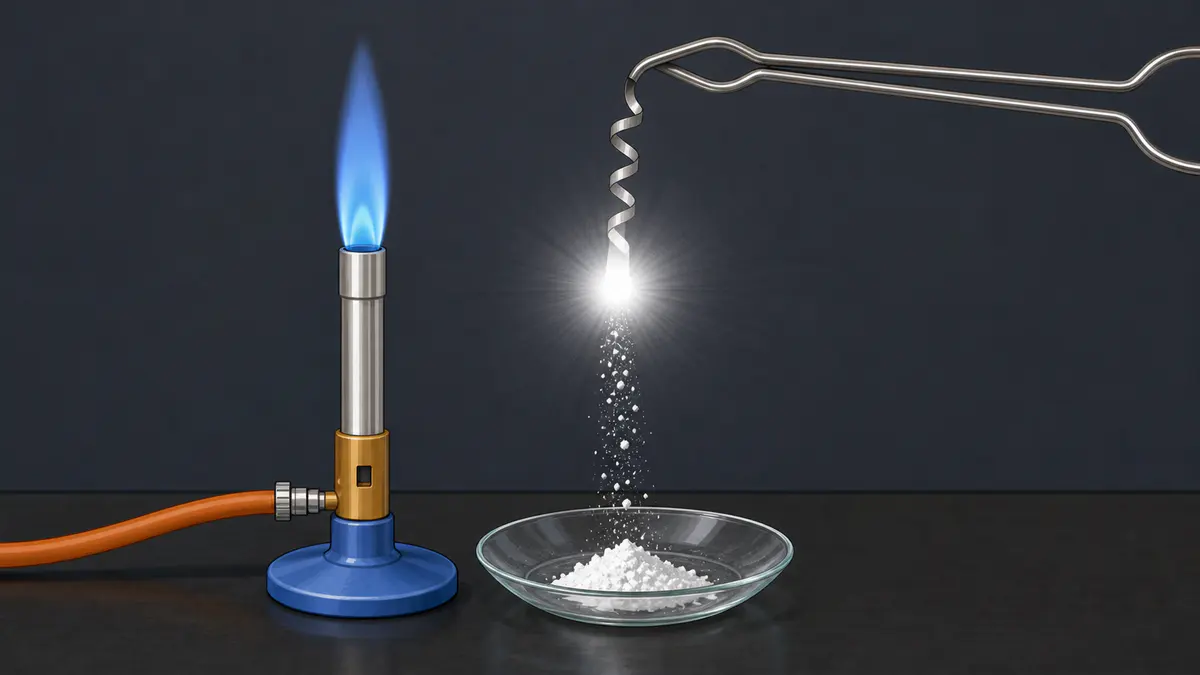
Activity 1.1 Burning magnesium ribbon
Caution: This activity needs the teacher's assistance. Wear suitable eyeglasses. Keep the burning ribbon as far away from your eyes as possible.
Clean a magnesium ribbon about 3-4 cm long by rubbing it with sandpaper.
Hold it with a pair of tongs.
Burn it using a spirit lamp or burner.
Collect the ash in a watch-glass.
Record what you observe.
Observation:
Magnesium burns with a dazzling white flame and changes into a white powder, magnesium oxide. Cleaning removes the magnesium oxide coating so that the ribbon can burn readily.
1
2
3
4
5
1Bunsen burner
2Magnesium ribbon
3Tongs
4Watch glass
5Magnesium oxide
NCERT Figure 1.1 · Activity 1.1
Burning magnesium ribbon in air
A cleaned magnesium ribbon is held with tongs in a burner flame, and the white ash is collected in a watch glass.
What to observe: Magnesium burns with a dazzling white flame and forms white magnesium oxide.
Figure 1.1 Burning of a magnesium ribbon in air and collection of magnesium oxide in a watch-glass.
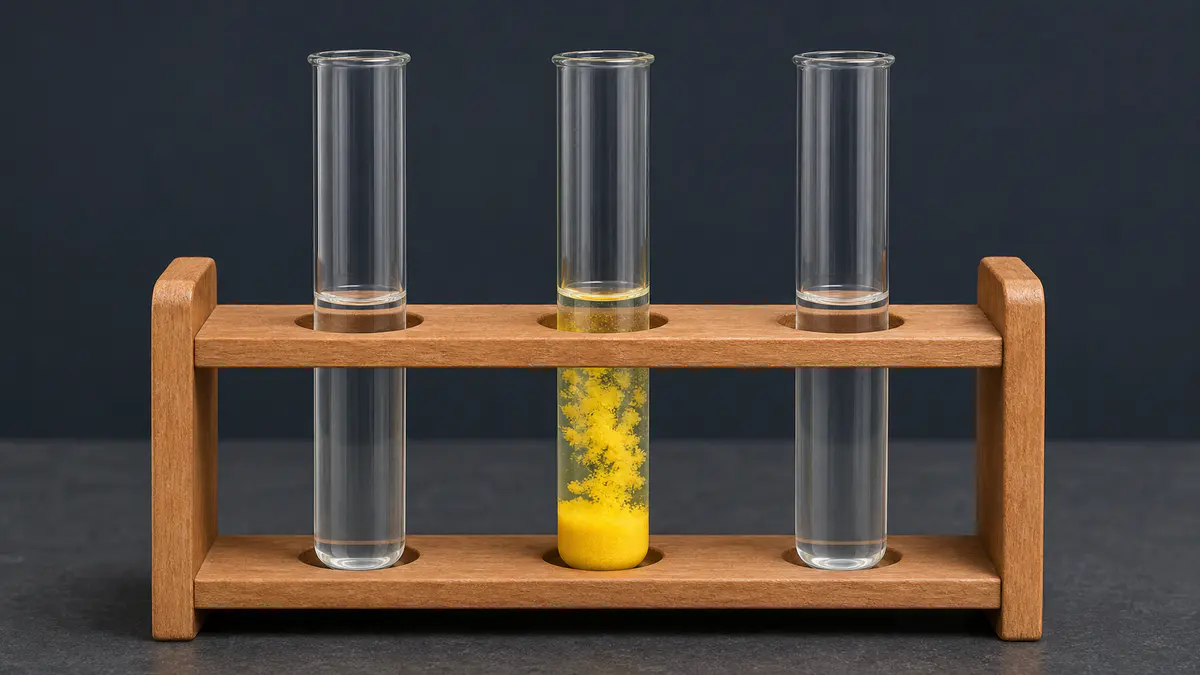
Activity 1.2 Lead nitrate and potassium iodide
Take lead nitrate solution in a test tube.
Add potassium iodide solution.
Observe the colour and physical state of the substance formed.
Observation: A yellow insoluble solid, lead iodide, forms. This solid is called a precipitate.
Figure legend
Lead nitrate solution
Potassium iodide solution
Test tube
Lead iodide precipitate
NCERT Activity 1.2 illustration
Lead nitrate and potassium iodide
Two colourless solutions are mixed in a test tube.
What to observe: A yellow precipitate of lead iodide forms.
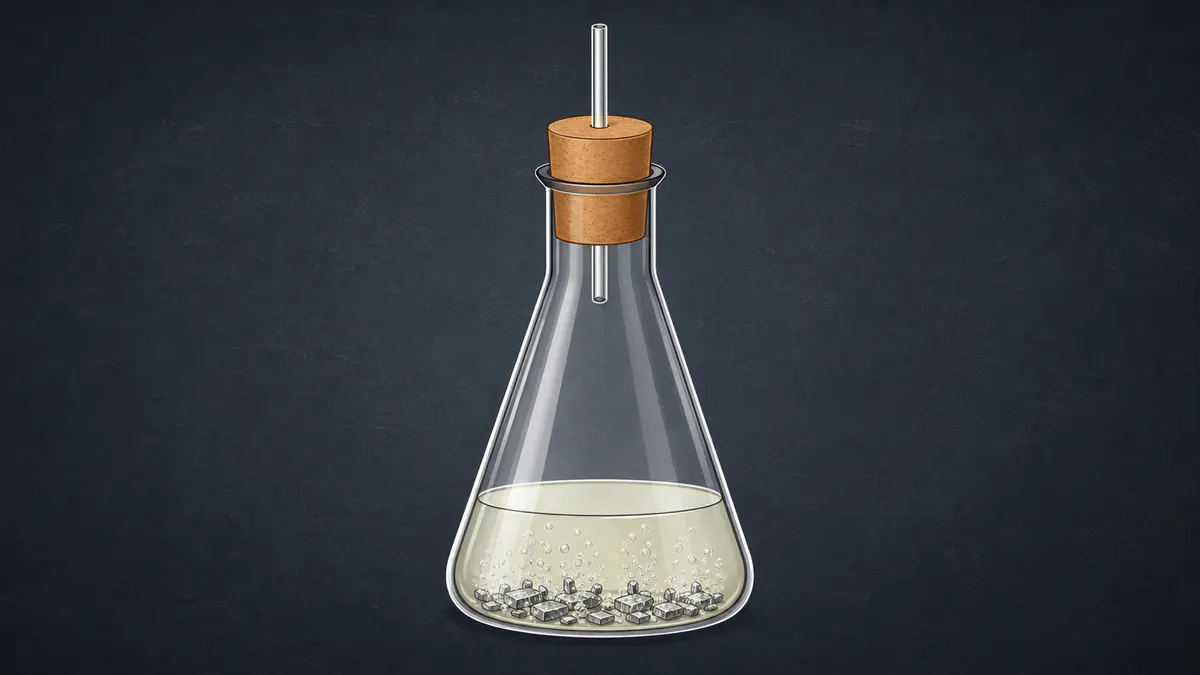
Activity 1.3 Zinc and dilute acid
Caution: Handle the acid with care.
Take a few zinc granules in a conical flask or test tube.
Add dilute hydrochloric acid or dilute sulphuric acid.
Observe what happens around the zinc granules.
Touch the outside of the container carefully and note any temperature change.
Observation: Hydrogen gas bubbles form and the container becomes warm. The evolution of a gas and rise in temperature show that a chemical reaction has occurred.
1
2
3
4
5
6
1Conical flask
2Cork
3Glass tube
4Zinc granules
5Dilute sulphuric acid
6Hydrogen gas
NCERT Figure 1.2 · Activity 1.3
Zinc with dilute sulphuric acid
Zinc granules react with dilute sulphuric acid in a corked conical flask with a short glass outlet tube.
What to observe: Hydrogen bubbles form and the flask becomes warm.
Figure 1.2 Formation of hydrogen gas by the action of dilute sulphuric acid on zinc.
From Activities 1.1-1.3, these observations help us recognise a chemical reaction:
change in state
change in colour
evolution of a gas
change in temperature
Section 1.1
Chemical Equations
A long sentence describing a reaction can be shortened to a word-equation:
Magnesium + Oxygen → Magnesium oxide(1.1)
Magnesium and oxygen are the reactants because they undergo chemical change. Magnesium oxide is the product formed by the reaction.
Reactants are written on the left-hand side, products on the right-hand side, and the arrow points towards the products.
Section 1.1.1
Writing a Chemical Equation
Chemical formulae make a word-equation shorter and more useful:
Mg + O₂ → MgO(1.2)
Count the atoms on the two sides. There are two oxygen atoms on the left but only one on the right. Equation (1.2) is therefore an unbalanced or skeletal chemical equation.
Remember: Never change a chemical formula to balance an equation. Changing H₂O into H₂O₂ changes water into a different substance.
⚠️ Common mistake
Common mistakes
Calling every visible change a chemical reaction. A chemical reaction forms one or more new substances.
Writing products on the left and reactants on the right.
Treating Activity 1.2 as NCERT Figure 1.2. Figure 1.2 belongs to Activity 1.3.
💡 Board tip
Board tips
In an observation question, state the visible change and what it indicates.
Write word-equations as Reactant + Reactant → Product.
Use correct formulae before attempting to balance an equation.
✏️ Quick practice
Quick practice
Name two observations that show a chemical reaction has occurred.
Identify the reactants and products in Zn + H₂SO₄ → ZnSO₄ + H₂.
Explain why Mg + O₂ → MgO is skeletal.
🔍 Practice feedback
Answer check
Try first, then reveal the answer
Any two of change in state, colour, gas evolution or temperature.
Reactants: zinc and sulphuric acid. Products: zinc sulphate and hydrogen.
Oxygen atoms are unequal on the two sides.
⏱️ 1-Minute revision
One-minute revision
A chemical reaction forms new substances.
Reactants are written on the left; products are written on the right.
Formula equations must use correct chemical formulae.
A skeletal equation has not yet been balanced.
🎭 Memory strip
Comic recap
Quick scene, quick smile, quick memory. Read this once and the idea sticks better.
Memory strip
Panel 01Priya
A gas, colour, state or temperature change can signal a reaction.
Panel 02Rahul
Reactants begin on the left, and products form on the right.
Panel 03Priya
Keep every chemical formula fixed when you write the equation.
Panel 04Rahul
If atom counts differ, the formula equation is still skeletal.
02
Guided balancing practice
1.1.2 Balanced Chemical Equations
Use conservation of mass, coefficients, and a repeatable atom-counting method to balance equations safely.
Section 1.1.2
Balanced Chemical Equations
The law of conservation of mass states that mass can neither be created nor destroyed in a chemical reaction. Therefore, every element must have the same number of atoms before and after the reaction.
Activity 1.3 can be written as:
Zinc + Sulphuric acid → Zinc sulphate + Hydrogen
Zn + H₂SO₄ → ZnSO₄ + H₂(1.3)
Equation (1.3) is already balanced: Zn = 1, H = 2, S = 1 and O = 4 on each side.
Now consider the skeletal equation:
Fe + H₂O → Fe₃O₄ + H₂(1.4)
Balancing by the hit-and-trial method
Step I: Draw boxes around every formula. Do not change anything inside a box.
Fe + H₂O → Fe₃O₄ + H₂(1.5)
Step II: Count the atoms.
Element
Reactants
Products
Fe
1
3
H
2
2
O
1
4
Step III: Start with the compound containing the most atoms. Balance oxygen by placing 4 before water:
Fe + 4H₂O → Fe₃O₄ + H₂(1.6)
Step IV: Balance hydrogen by placing 4 before hydrogen:
Fe + 4H₂O → Fe₃O₄ + 4H₂(1.7)
Step V: Balance iron by placing 3 before iron:
3Fe + 4H₂O → Fe₃O₄ + 4H₂(1.8)
Step VI: Check every element. Fe: 3 = 3, H: 8 = 8, O: 4 = 4. Use the smallest whole-number coefficients:
3Fe + 4H₂O → Fe₃O₄ + 4H₂(1.9)
Step VII: Writing symbols of physical states
3Fe(s) + 4H₂O(g) → Fe₃O₄(s) + 4H₂(g)(1.10)
Here (s) means solid, (l) liquid, (g) gas and (aq) an aqueous solution. In equation (1.10), (g) with water shows that water is used as steam.
Temperature, pressure and catalysts are written above or below the arrow when required:
Write a balanced chemical equation with state symbols for the following reactions.
Try first, then reveal the answer
(i) Solutions of barium chloride and sodium sulphate in water react to give insoluble barium sulphate and the solution of sodium chloride.
⚠️ Common mistake
Common mistakes
Changing subscripts instead of coefficients.
Forgetting the unnumbered atom check before adding states.
Writing liquid water in equation (1.10); NCERT uses steam, H₂O(g).
Omitting 340 atm, sunlight or chlorophyll from condition-based equations.
💡 Board tip
Board tips
Balance formulae first; add states and conditions only after the atom count is correct.
Use the smallest whole-number coefficients.
Check every element once more before finalising the answer.
✏️ Quick practice
Quick practice
Balance Al + O₂ → Al₂O₃ without changing any formula.
🔍 Practice feedback
Answer check
Try first, then reveal the answer
4Al + 3O₂ → 2Al₂O₃
⏱️ 1-Minute revision
One-minute revision
Conservation of mass requires equal atom counts.
Coefficients may change; subscripts may not.
(aq) means dissolved in water.
Conditions belong above or below the reaction arrow.
🎭 Memory strip
Comic recap
Quick scene, quick smile, quick memory. Read this once and the idea sticks better.
Memory strip
Panel 01Priya
Conservation of mass means every atom must be accounted for.
Panel 02Rahul
I change coefficients, never the subscripts inside a formula.
Panel 03Priya
Use the smallest whole-number coefficients and check every element.
Panel 04Rahul
Add physical states and reaction conditions only after balancing.
03
Visual explainer
1.2 Types of Chemical Reactions - 1.2.1 Combination and 1.2.2 Decomposition
Learn how combination and decomposition reactions work, plus the difference between thermal, electrolytic, and photolytic breakdown.
Section 1.2
Types of Chemical Reactions
Atoms do not change into atoms of another element, disappear or appear from nowhere during a chemical reaction. Existing bonds break and new bonds form, producing new substances.
Section 1.2.1
Combination Reaction
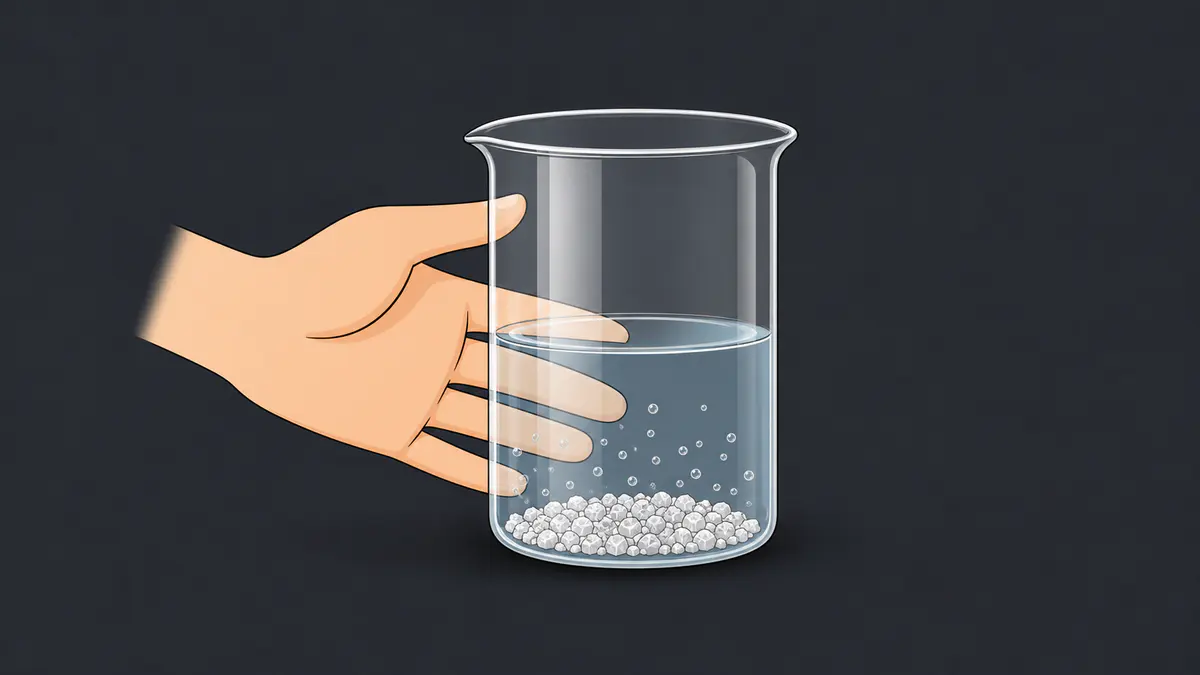
Activity 1.4 Quicklime and water
Take a small amount of calcium oxide, or quicklime, in a beaker.
Slowly add water.
Touch the outside of the beaker carefully.
Record the temperature change.
Observation: The beaker becomes hot. Calcium oxide reacts vigorously with water to form calcium hydroxide, or slaked lime, and releases heat.
1
2
3
4
5
1Beaker
2Hand checking temperature
3Quicklime
4Water
5Slaked lime mixture
NCERT Figure 1.3 · Activity 1.4
Quicklime and water
Water is added slowly to quicklime in a beaker, whose outside is touched carefully to check the temperature.
What to observe: The beaker becomes hot as slaked lime forms.
Figure 1.3 Formation of slaked lime by the reaction of calcium oxide with water.
CaO(s) + H₂O(l) → Ca(OH)₂(aq) + Heat(1.13)
Two reactants form a single product. This is a combination reaction.
Do You Know? Slaked lime solution is used for whitewashing. It slowly reacts with carbon dioxide in air. Calcium carbonate forms after two to three days and gives the wall a shiny finish. Marble also has the formula CaCO₃.
Ca(OH)₂(aq) + CO₂(g) → CaCO₃(s) + H₂O(l)(1.14)
Other combination reactions are:
C(s) + O₂(g) → CO₂(g)(1.15)
2H₂(g) + O₂(g) → 2H₂O(l)(1.16)
Activity 1.4 also releases a large amount of heat. A reaction that releases heat along with its products is exothermic.
Burning natural gas:
CH₄(g) + 2O₂(g) → CO₂(g) + 2H₂O(g)(1.17)
Respiration is exothermic because glucose reacts with oxygen in our cells and releases usable energy:
Decomposition of vegetable matter into compost is also exothermic.
Source prompt: Identify the reaction in Activity 1.1. Magnesium and oxygen form one product while heat is given out, so it is an exothermic combination reaction.
Section 1.2.2
Decomposition Reaction
Activity 1.5 Heating ferrous sulphate crystals
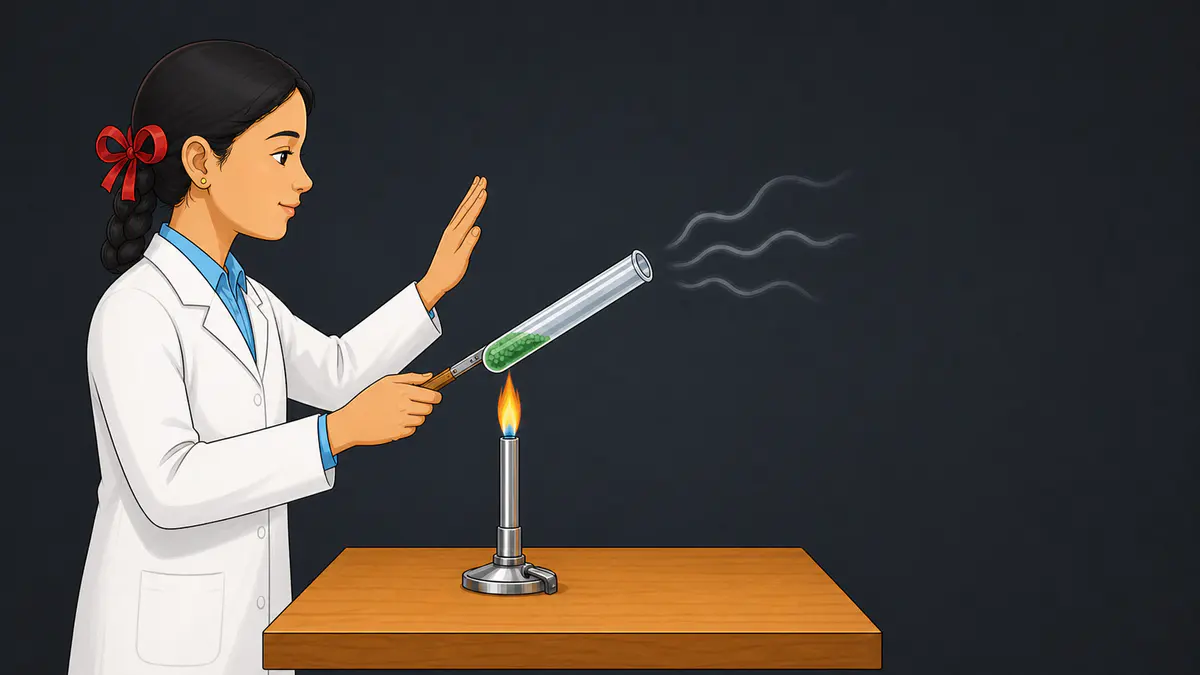
Caution: Keep the mouth of the boiling tube pointed away from yourself and others. If the odour is checked, gently waft the gas towards the nose; do not smell it directly.
Take about 2 g ferrous sulphate crystals in a dry boiling tube.
Note their green colour.
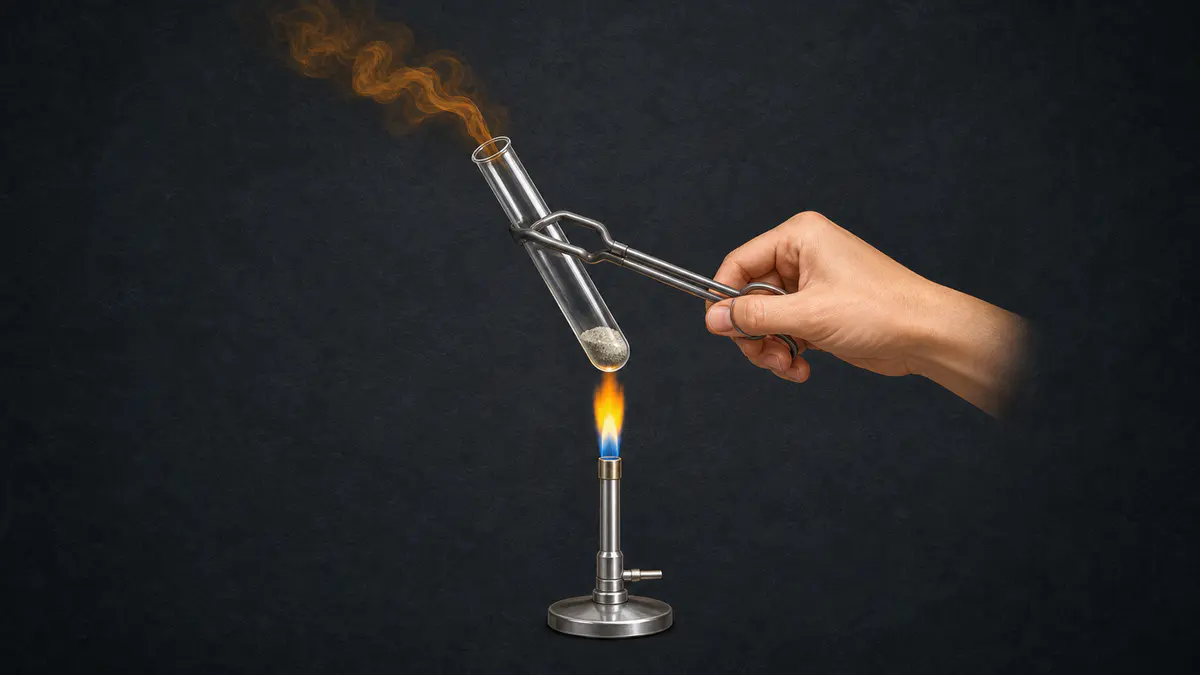
Heat the tube over a burner or spirit lamp as shown in Figure 1.4.
Observe the colour after heating and the characteristic odour of burning sulphur.
Observation and explanation: Green FeSO₄·7H₂O crystals first lose water on heating. The remaining ferrous sulphate then decomposes. Brown ferric oxide remains, while sulphur dioxide and sulphur trioxide escape as gases.
1
2
3
4
5
6
❓ Study questions
Questions and answers
Question 1
A solution of a substance ‘X’ is used for whitewashing.
Try first, then reveal the answer
(i) Name the substance ‘X’ and write its formula.Answer: Calcium oxide, or quicklime, CaO.
(ii) Write the reaction of the substance ‘X’ named in (i) above with water.Answer:CaO(s) + H₂O(l) → Ca(OH)₂(aq) + Heat
Question 2
Why is the amount of gas collected in one of the test tubes in Activity 1.7 double of the amount collected in the other? Name this gas.
Try first, then reveal the answer
Water has hydrogen and oxygen in a 2:1 ratio. During electrolysis, it therefore produces twice the volume of hydrogen as oxygen. The gas collected in double amount is hydrogen.
⚠️ Common mistake
Common mistakes
Calling every decomposition reaction thermal decomposition.
Numbering the electrolysis equation as (1.21).
Forgetting that ferrous sulphate crystals first lose water and then decompose.
Calling an energy-absorbing reaction exothermic.
Giving the 2:1 volume ratio when a question asks for the 1:8 mass ratio.
💡 Board tip
Board tips
State the energy source when naming a decomposition reaction.
Include the observation as well as the reaction type in activity questions.
For a 2:1 gas-volume answer, name hydrogen explicitly.
In an electrolysis answer, label hydrogen at the cathode and oxygen at the anode.
✏️ Quick practice
Quick practice
Classify equations (1.19), (1.22) and the electrolysis equation by their energy source.
Why is dilute sulphuric acid added before electrolysing water?
State the cathode:anode volume ratio and mass ratio.
🔍 Practice feedback
Answer check
Try first, then reveal the answer
(1.19) thermal; (1.22) photochemical or photolytic; electrolysis electrolytic decomposition.
The acid provides ions and increases electrical conductivity.
Volume ratio H₂:O₂ = 2:1; mass ratio H₂:O₂ = 1:8.
⏱️ 1-Minute revision
One-minute revision
Combination: two or more reactants form one product.
Decomposition: one reactant forms two or more products.
Exothermic reactions release energy; endothermic reactions absorb it.
Decomposition may be driven by heat, electricity or light.
During water electrolysis, H₂ forms at the cathode and O₂ at the anode.
🎭 Memory strip
Comic recap
Quick scene, quick smile, quick memory. Read this once and the idea sticks better.
Memory strip
Panel 01Priya
Combination joins two or more reactants into one product.
Panel 02Rahul
Decomposition splits one reactant into two or more products.
Panel 03Priya
Heat, electricity or light can supply the energy for decomposition.
1.2.3 Displacement and 1.2.4 Double Displacement Reactions
Use relative reactivity and ion exchange to spot displacement, double displacement, and precipitate-forming reactions.
Section 1.2.3
Displacement Reaction
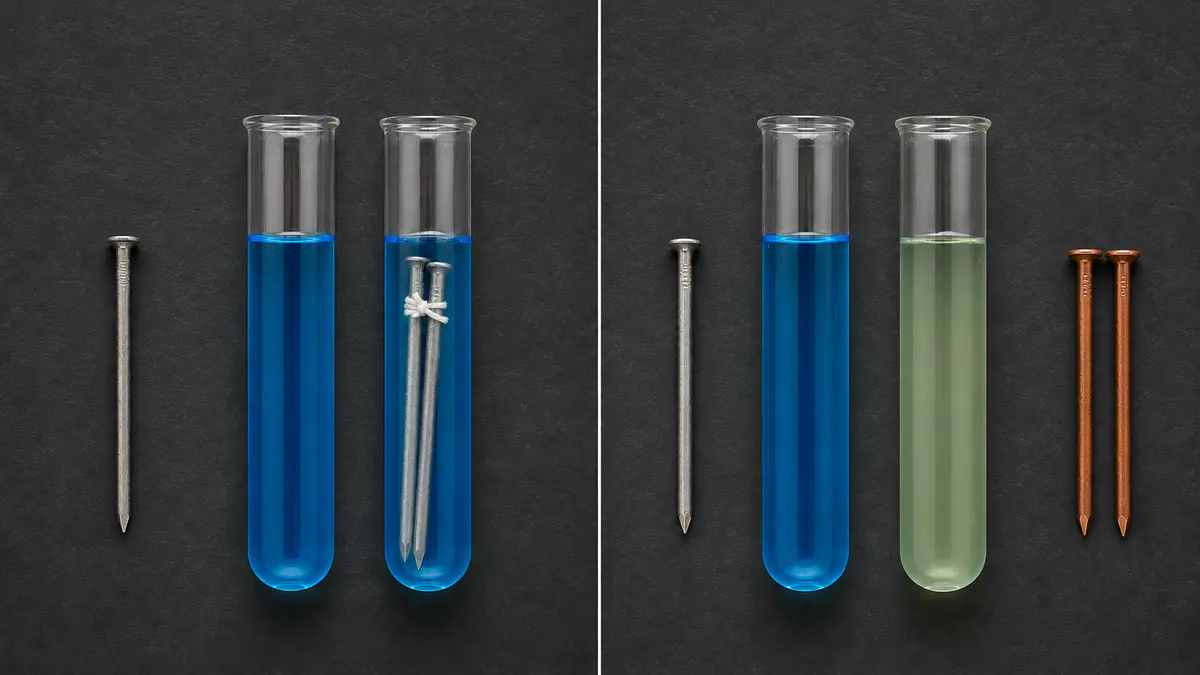
Activity 1.9 Iron nails in copper sulphate
Clean three iron nails by rubbing them with sandpaper.
Mark two test tubes as A and B. Put about 10 mL copper sulphate solution in each.
Tie two nails with thread and immerse them in test tube B for about 20 minutes.
Keep the third nail aside for comparison.
Remove the immersed nails after 20 minutes.
Compare the blue colour in test tubes A and B.
Compare the immersed nails with the nail kept aside.
1
2
3
4
5
1Clean comparison nail
2Blue copper sulphate control
3Two immersed nails
4Pale-green iron sulphate
5Copper-coated nails
NCERT Figure 1.8(a)-(b) · Activity 1.9
Iron nails in copper sulphate
Three nails and test tubes A/B provide a before-and-after comparison.
What to observe: Two immersed nails gain a copper coating and the reaction solution becomes pale green.
Figure 1.8(a)-(b) Iron nails and copper sulphate solutions compared before and after the experiment.
Observation: The immersed nails become brownish and the blue solution in test tube B fades. Iron is more reactive than copper, so iron displaces copper. Copper deposits on the nails and pale-green iron sulphate forms.
Fe(s) + CuSO₄(aq) → FeSO₄(aq) + Cu(s)(1.24)
A reaction in which a more reactive element removes a less reactive element from its compound is a displacement reaction.
Zn(s) + CuSO₄(aq) → ZnSO₄(aq) + Cu(s)(1.25)
Pb(s) + CuCl₂(aq) → PbCl₂(aq) + Cu(s)(1.26)
Zinc and lead are more reactive than copper, so they displace copper from its compounds.
Section 1.2.4
Double Displacement Reaction
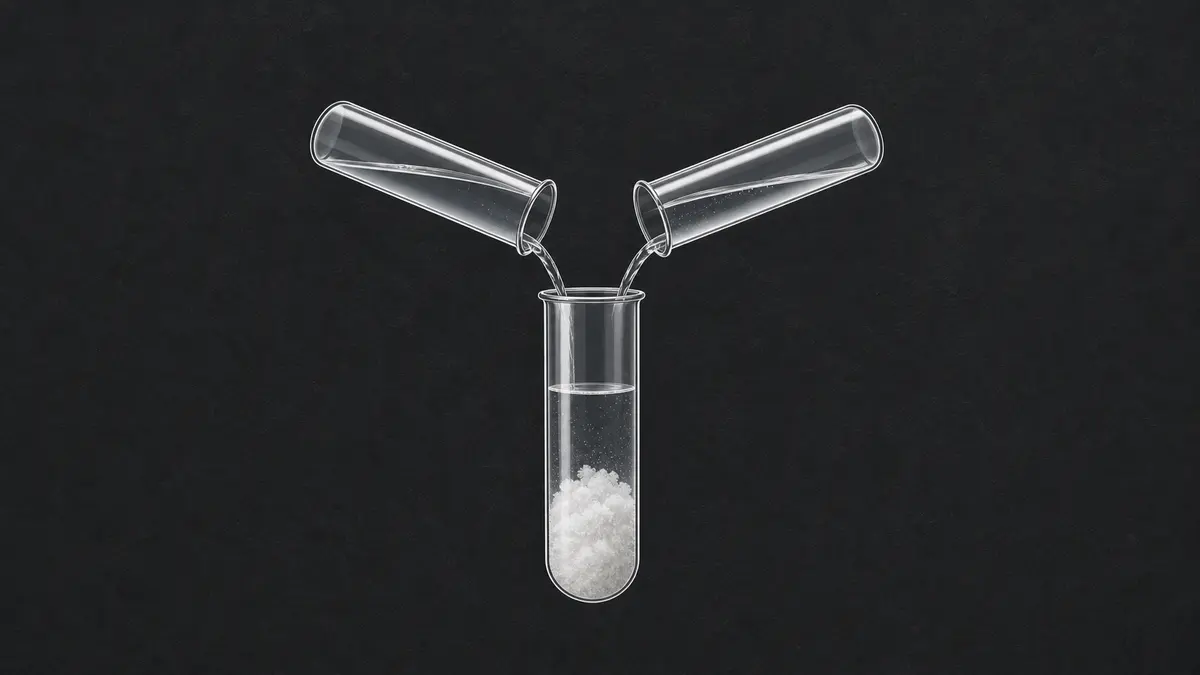
Activity 1.10 Sodium sulphate and barium chloride
Take about 3 mL sodium sulphate solution in one test tube.
Take about 3 mL barium chloride solution in another test tube.
Mix the two solutions.
Record the substance formed.
1
2
3
4
1Sodium sulphate solution
2Barium chloride solution
3Receiving test tube
4Barium sulphate precipitate
NCERT Figure 1.9 · Activity 1.10
Formation of barium sulphate
Separate sodium sulphate and barium chloride solutions are mixed.
What to observe: A white insoluble barium sulphate precipitate forms.
⚠️ Common mistake
Common mistakes
Calling the copper coating rust.
Forgetting that both test tubes begin with blue copper sulphate solution.
Calling every double displacement reaction a precipitation reaction; a precipitate must actually form.
Confusing an element replacement with ion exchange.
💡 Board tip
Board tips
Write the observation before explaining displacement.
Use (s) for the precipitate in a precipitation equation.
Name the more reactive element and the displaced element.
✏️ Quick practice
Quick practice
Why does test tube B become less blue in Activity 1.9?
Why is equation (1.27) both double displacement and precipitation?
🔍 Practice feedback
Answer check
Try first, then reveal the answer
Blue CuSO₄ is used up and pale-green FeSO₄ forms.
The ions exchange partners and insoluble BaSO₄ forms.
⏱️ 1-Minute revision
One-minute revision
More reactive elements displace less reactive elements.
Double displacement reactions exchange ions.
A precipitate is an insoluble solid formed from solutions.
🎭 Memory strip
Comic recap
Quick scene, quick smile, quick memory. Read this once and the idea sticks better.
Memory strip
Panel 01Priya
Iron is more reactive, so it replaces copper from copper sulphate.
Panel 02Rahul
That one-element replacement is a displacement reaction.
Panel 03Priya
In double displacement, two compounds exchange ions.
Panel 04Rahul
If an insoluble solid forms, the reaction is also precipitation.
05
Revision sprint
1.2.5 Oxidation and Reduction; 1.3 Effects of Oxidation in Everyday Life
Revise oxidation, reduction, redox, corrosion, and rancidity with prevention methods and quick examples.
Section 1.2.5
Oxidation and Reduction
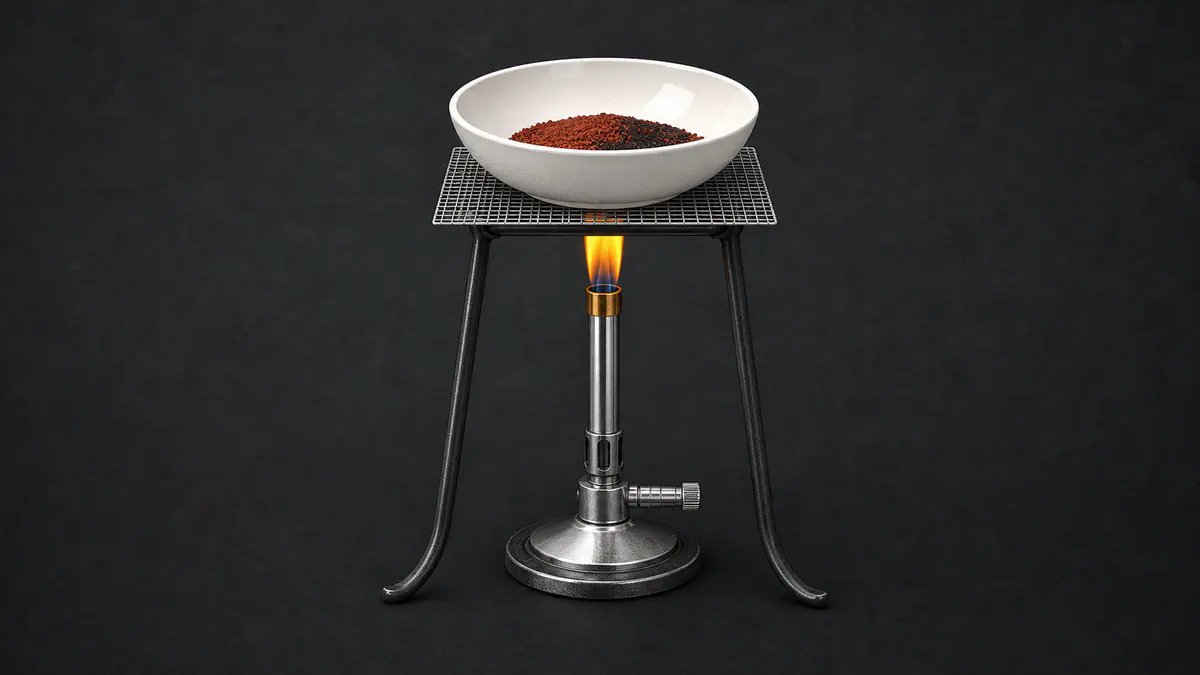
Activity 1.11 Heating copper powder
Place about 1 g copper powder in a china dish.
Heat the dish as shown in Figure 1.10.
Observe the colour of the copper surface.
1
2
3
4
5
6
1China dish
2Copper powder
3Copper oxide
4Wire gauze
5Tripod stand
6Bunsen burner
NCERT Figure 1.10 · Activity 1.11
Heating copper powder
Copper powder is heated in a china dish on wire gauze and a tripod.
What to observe: The reddish-brown copper surface becomes black copper oxide.
Figure 1.10 Oxidation of copper to copper oxide.
What do you observe? Why has this black substance formed?
Observation: The reddish-brown copper surface becomes coated with black copper(II) oxide because oxygen is added to copper.
2Cu + O₂ →[Heat] 2CuO(1.28)
If hydrogen is passed over the heated copper oxide, the black coating turns brown again. Copper oxide loses oxygen and copper is obtained:
CuO + H₂ →[Heat] Cu + H₂O(1.29)
A substance that gains oxygen is oxidised. A substance that loses oxygen is reduced. In equation (1.29), hydrogen gains oxygen and is oxidised, while copper(II) oxide loses oxygen and is reduced. Because the two processes happen together, it is an oxidation-reduction or redox reaction.
CuO + H₂ →[Heat] Cu + H₂O(1.30) Oxidation: H₂ → H₂O Reduction: CuO → Cu
Other redox examples are:
ZnO + C → Zn + CO(1.31)
Carbon gains oxygen and is oxidised to carbon monoxide. Zinc oxide loses oxygen and is reduced to zinc.
MnO₂ + 4HCl → MnCl₂ + 2H₂O + Cl₂(1.32)
Hydrochloric acid loses hydrogen and is oxidised to chlorine. Manganese dioxide loses oxygen and is reduced to manganese chloride; the removed oxygen combines with hydrogen to form water.
In NCERT terms:
Oxidation: gain of oxygen or loss of hydrogen.
Reduction: loss of oxygen or gain of hydrogen.
❓ Study questions
Questions and answers
Question 1
Why does the colour of copper sulphate solution change when an iron nail is dipped in it?
Try first, then reveal the answer
Iron is more reactive than copper, so it displaces copper from copper sulphate. Pale-green iron sulphate forms and copper deposits on the nail; therefore, the blue colour fades.
Question 2
Give an example of a double displacement reaction other than the one given in Activity 1.10.
Try first, then reveal the answer
Pb(NO₃)₂(aq) + 2KI(aq) → PbI₂(s) + 2KNO₃(aq). Lead iodide is a yellow precipitate.
Question 3
Identify the substances that are oxidised and the substances that are reduced in the following reactions.
Try first, then reveal the answer
(i) 4Na(s) + O₂(g) → 2Na₂O(s)Answer: Sodium gains oxygen and is oxidised. Oxygen is reduced while sodium oxide forms.
(ii) CuO(s) + H₂(g) → Cu(s) + H₂O(l)Answer: Hydrogen gains oxygen and is oxidised to water. Copper oxide loses oxygen and is reduced to copper.
Section 1.3
Have You Observed the Effects of Oxidation Reactions in Everyday Life?
Section 1.3.1
Corrosion
New iron articles are shiny, but iron left exposed develops reddish-brown rust. When a metal is attacked by moisture, acids or other substances around it, the metal is said to corrode and the process is called corrosion.
Iron forms reddish-brown rust.
Silver develops a black coating.
Copper develops a green coating.
Corrosion damages car bodies, bridges, iron railings, ships and other metal objects. Rusting causes serious economic loss because damaged iron must be repaired or replaced. Paint limits the contact of iron with air and moisture, so it slows rusting.
Board extension: Copper corrosion and material choice
This extension prepares you for a current CBSE application pattern. It is not an additional NCERT section.
Copper exposed to moist air slowly develops a green coating of basic copper carbonate.
This coating stays attached and helps shield the copper below from further attack.
Iron rust is loose and flaky. When it falls away, fresh iron is exposed and corrosion can continue.
Section 1.3.2
Rancidity
When fats and oils are oxidised, their smell and taste change. This spoilage is called rancidity.
Rancidity can be slowed by:
adding antioxidants to food containing fats and oils;
keeping food in airtight containers;
flushing packets with nitrogen so oxygen cannot easily reach the food.
Recall Activity 1.1
Magnesium burns with a dazzling flame in oxygen and changes into white magnesium oxide. Magnesium gains oxygen, so it is being oxidised.
What you have learnt
A complete chemical equation represents reactants, products and physical states symbolically.
An equation must be balanced so that every element has the same number of atoms on both sides.
Combination reactions form one new substance from two or more substances.
Decomposition reactions split one substance into two or more substances.
A displacement reaction occurs when one element displaces another from its compound.
A double displacement reaction exchanges atoms or groups of atoms, called ions.
Precipitation reactions produce insoluble salts.
Oxidation is gain of oxygen or loss of hydrogen; reduction is loss of oxygen or gain of hydrogen.
⚠️ Common mistake
Common mistakes
Saying copper oxide is oxidised in equation (1.29); it loses oxygen and is reduced.
Calling every coating on a metal rust. Rusting refers specifically to iron.
Defining rancidity as ordinary bacterial decay instead of oxidation of fats and oils.
💡 Board tip
Board tips
Name both the oxidised and reduced substances in a redox answer.
Use coating colour plus metal name in corrosion questions.
For rancidity, state the role of oxygen and then give a prevention method.
✏️ Quick practice
Quick practice
In equation (1.31), which substance is oxidised and which is reduced?
Why is nitrogen used in chips packets?
🔍 Practice feedback
Answer check
Try first, then reveal the answer
Carbon is oxidised; zinc oxide is reduced.
Nitrogen limits contact with oxygen and delays rancidity.
⏱️ 1-Minute revision
One-minute revision
Oxidation and reduction happen together.
Corrosion attacks metals through their surroundings.
Rancidity is oxidation of fats and oils.
Reduce contact with oxygen to slow rancidity.
🎭 Memory strip
Comic recap
Quick scene, quick smile, quick memory. Read this once and the idea sticks better.
Memory strip
Panel 01Priya
Copper gains oxygen and forms black copper oxide.
Panel 02Rahul
Hydrogen removes oxygen from copper oxide, so copper oxide is reduced.
Panel 03Priya
Paint blocks air and moisture from reaching iron.
Panel 04Rahul
Less oxygen in the packet means slower rancidity.
06
Exam practice
NCERT Chapter Exercises and Revision
Attempt all twenty NCERT exercises, reveal concise answers, and finish with a repeatable revision ladder.
How to use this lesson
Attempt every question on paper first. Reveal the answer only after writing your own. For equations, check formulae, coefficients, physical states and conditions separately.
❓ Study questions
Questions and answers
Question 1
Which of the statements about the reaction below are incorrect? 2PbO(s) + C(s) → 2Pb(s) + CO₂(g) (a) Lead is getting reduced. (b) Carbon dioxide is getting oxidised. (c) Carbon is getting oxidised. (d) Lead oxide is getting reduced. (i) (a) and (b) (ii) (a) and (c) (iii) (a), (b) and (c) (iv) all
Try first, then reveal the answer
(i) (a) and (b). Lead oxide loses oxygen and is reduced to lead. Carbon gains oxygen and is oxidised to carbon dioxide. Therefore, statements (c) and (d) are correct.
Question 2
Fe₂O₃ + 2Al → Al₂O₃ + 2Fe The above reaction is an example of a (a) combination reaction. (b) double displacement reaction. (c) decomposition reaction. (d) displacement reaction.
Try first, then reveal the answer
(d) Displacement reaction. Aluminium is more reactive than iron and displaces iron from iron oxide.
Question 3
What happens when dilute hydrochloric acid is added to iron fillings? Tick the correct answer. (a) Hydrogen gas and iron chloride are produced. (b) Chlorine gas and iron hydroxide are produced. (c) No reaction takes place. (d) Iron salt and water are produced.
Try first, then reveal the answer
(a) Hydrogen gas and iron chloride are produced.
Fe(s) + 2HCl(aq) → FeCl₂(aq) + H₂(g)
Question 4
What is a balanced chemical equation? Why should chemical equations be balanced?
Try first, then reveal the answer
A balanced chemical equation has the same number of atoms of every element on the reactant and product sides. Equations must be balanced to obey the law of conservation of mass: mass can neither be created nor destroyed during a chemical reaction.
Question 5
Translate the following statements into chemical equations and then balance them. (a) Hydrogen gas combines with nitrogen to form ammonia. (b) Hydrogen sulphide gas burns in air to give water and sulpur dioxide. (c) Barium chloride reacts with aluminium sulphate to give aluminium chloride and a precipitate of barium sulphate. (d) Potassium metal reacts with water to give potassium hydroxide and hydrogen gas.
Try first, then reveal the answer
(a)N₂(g) + 3H₂(g) → 2NH₃(g) Check: N = 2 and H = 6 on both sides.
(b)2H₂S(g) + 3O₂(g) → 2H₂O(l) + 2SO₂(g) Check: H = 4, S = 2 and O = 6 on both sides.
(c)3BaCl₂(aq) + Al₂(SO₄)₃(aq) → 2AlCl₃(aq) + 3BaSO₄(s)BaSO₄ is the precipitate.
Write the balanced chemical equation for the following and identify the type of reaction in each case. (a) Potassium bromide(aq) + Barium iodide(aq) → Potassium iodide(aq) + Barium bromide(s) (b) Zinc carbonate(s) → Zinc oxide(s) + Carbon dioxide(g) (c) Hydrogen(g) + Chlorine(g) → Hydrogen chloride(g) (d) Magnesium(s) + Hydrochloric acid(aq) → Magnesium chloride(aq) + Hydrogen(g)
What is the difference between displacement and double displacement reactions? Write equations for these reactions.
Try first, then reveal the answer
In a displacement reaction, one more reactive element replaces a less reactive element from its compound:
Zn(s) + CuSO₄(aq) → ZnSO₄(aq) + Cu(s)
In a double displacement reaction, two compounds exchange ions:
Na₂SO₄(aq) + BaCl₂(aq) → BaSO₄(s) + 2NaCl(aq)
Question 14
In the refining of silver, the recovery of silver from silver nitrate solution involved displacement by copper metal. Write down the reaction involved.
Try first, then reveal the answer
Copper is more reactive than silver and displaces it:
Cu(s) + 2AgNO₃(aq) → Cu(NO₃)₂(aq) + 2Ag(s)
Question 15
What do you mean by a precipitation reaction? Explain by giving examples.
Try first, then reveal the answer
A precipitation reaction is a reaction between solutions that produces an insoluble solid called a precipitate.
Example 1:Na₂SO₄(aq) + BaCl₂(aq) → BaSO₄(s) + 2NaCl(aq) — white BaSO₄ precipitate.
A shiny brown coloured element ‘X’ on heating in air becomes black in colour. Name the element ‘X’ and the black coloured compound formed.
Try first, then reveal the answer
X is copper. The black compound is copper(II) oxide, CuO:
2Cu + O₂ →[Heat] 2CuO
Question 18
Why do we apply paint on iron articles?
Try first, then reveal the answer
Paint forms a protective barrier that prevents air and moisture from reaching iron. Since both are needed for rusting, painting slows corrosion.
Question 19
Oil and fat containing food items are flushed with nitrogen. Why?
Try first, then reveal the answer
Nitrogen replaces most of the oxygen-rich air inside the packet. With less oxygen available, oxidation of fats and oils slows, so rancidity is delayed.
Question 20
Explain the following terms with one example each. (a) Corrosion (b) Rancidity
Try first, then reveal the answer
(a) Corrosion: The gradual attack of a metal by moisture, acids or other substances in its surroundings. Example: iron forms reddish-brown rust.
(b) Rancidity: Oxidation of fats and oils that changes their smell and taste. Example: an opened packet of oily food develops an unpleasant smell and taste after long exposure to air.
Group Activity
Take four beakers and label them A, B, C and D.
Put 25 mL water in A, B and C, and copper sulphate solution in D.
Measure and record the temperature of every liquid.
Add two spatulas of potassium sulphate, ammonium nitrate, anhydrous copper sulphate and fine iron filings to A, B, C and D respectively. Stir each mixture.
Measure and record the final temperature.
Use the temperature changes to decide which processes are exothermic and which are endothermic.
Safety: Perform the activity under teacher supervision and avoid direct contact with the chemicals.
⚠️ Common mistake
Common mistakes
Omitting physical states when the question gives them.
Naming a reaction without explaining the reactant-product pattern.
Giving only one example when a question asks for two.
Forgetting to write heat, light or electricity over the arrow.
💡 Board tip
Board tips
Underline the final balanced equation after checking atoms.
In reasoning answers, write cause → process → observation.
For redox, name both substances and the oxygen change.
For multi-part questions, label every subpart exactly.
Revision ladder
Write correct formulae. 2. Balance coefficients. 3. Add states. 4. Add conditions. 5. Identify the pattern. 6. State the observation or reason.
⏱️ 1-Minute revision
One-minute revision
Balance by coefficients, never by changing formulae.
Conditions are part of a complete equation.
Activity observations often identify the reaction type.
Full-mark answers explain why, not only what.
🎭 Memory strip
Comic recap
Quick scene, quick smile, quick memory. Read this once and the idea sticks better.
Memory strip
Panel 01Priya
First write the correct chemical formulae.
Panel 02Rahul
Then balance coefficients and add physical states and conditions.
Panel 03Priya
Name the reaction pattern and explain the observation or reason.
Panel 04Rahul
Check every requested example and subpart before finishing.
07
Board exam supplement
Board Exam Practice - Verified Previous-Year Questions
Practise visually verified board questions from 2023-2026, learn how marking points are earned, and close the oxidising-agent and reducing-agent gap.
Purpose and source boundary
The first six lessons follow the current NCERT textbook. This lesson is a separate exam-practice supplement. It does not add or renumber any textbook topic.
The previous-year questions below were checked against the original English board-paper pages on 26 July 2026. A question shows what CBSE asked in that historical paper. It does not prove what the current year's paper will contain.
The marking points are platform study guides. They are not official CBSE marking schemes themselves, but the answers for these nine questions were checked against CBSE's published marking-scheme value points for 2023-2026. The explanations sometimes add reasoning so that you understand why a point earns credit.
Your full-marks practice route
Use the chapter in this order. Do not jump straight to the answer check.
Finish the six NCERT lessons and the chapter quiz.
Use the balancing workbench until all four equations are completed without hints.
Write each PYQ answer in its practice box. Reveal the marking points only after writing.
Open every weak-skill repair link, revise that exact section, and start a fresh attempt.
Complete the five current-pattern challenges.
Attempt Diagnostic A under its 30-minute writing limit.
Attempt Diagnostic B as a separate transfer check.
Return for fresh D3 and D7 attempts when the retention card says they are due. A date alone never marks revision complete.
[REMEMBER: A high quiz score proves recognition. Full board confidence also needs complete written answers, balanced equations, timed work and later retention.]
The full-mark answer pattern
For an activity or reaction question, use O-I-E-C:
Observation: What was seen, smelled or felt?
Inference: What substance formed or what change occurred?
Equation: Write the balanced equation with states and conditions when known.
Classification: Name the reaction and justify the pattern.
For a reason question, use cause → process → result. For a multi-part question, copy the same (a), (b), (i) and (ii) labels into the answer.
Board extension: oxidising and reducing agents
This vocabulary appears in board questions and also connects Chapter 1 with later chemistry chapters.
An oxidising agent causes another substance to be oxidised. The oxidising agent itself is reduced.
A reducing agent causes another substance to be reduced. The reducing agent itself is oxidised.
In CuO + H₂ →[Heat] Cu + H₂O:
H₂ gains oxygen, so H₂ is oxidised and acts as the reducing agent.
CuO loses oxygen, so CuO is reduced and acts as the oxidising agent.
[TIP: Track what happens to each reactant first. Name the agent only after identifying which reactant is oxidised and which is reduced.]
A two-pass method for unfamiliar equations
Pass 1 - Use oxygen or hydrogen.
Verified previous-year questions
PYQ 1 - Observation, reaction type and equation - 2 marks
What is observed when aqueous solutions of potassium iodide and lead nitrate are mixed together? Name the type of reaction and write the chemical equation for the reaction that occurs.
Silver chloride kept in a china dish turns grey in sunlight.
(a) Write the colour of silver chloride when it was kept in the china dish.
(b) Name the type of chemical reaction taking place and write the chemical equation for the reaction.
(c) State one use of the reaction. Name one more chemical which can be used for the same purpose.
Write before checking
PYQ 2 written attempt
3 marks · Attempt 1
Latest official SQP-pattern challenges
As checked on 26 July 2026, CBSE's newest published main-subject Class X SQP is the 2025-26 paper. Its Chapter 1 questions combine more than one skill: balancing with redox reasoning, comparing displacement observations, diagnosing an electrolysis setup, evaluating corrosion in a material choice, and distinguishing double displacement from precipitation in a neutralisation. The five questions below are original platform questions built on those patterns. They are not previous-year questions and are not predictions.
Official references: [CBSE Class X 2025-26 SQP page](https://cbseacademic.nic.in/SQP_CLASSX_2025-26.html), [Science SQP](https://cbseacademic.nic.in/web_material/SQP/ClassX_2025_26/Science-SQP.pdf), and [Science marking scheme](https://cbseacademic.nic.in/web_material/SQP/ClassX_2025_26/Science-MS.pdf).
Current-pattern challenge 1 - Balance, classify and track redox - 2 marks
Balance both equations:
Fe₂O₃ + Al → Al₂O₃ + Fe
C₂H₆ + O₂ → CO₂ + H₂O
State whether each is a redox reaction. For the first equation, name one substance oxidised and one substance reduced.
Write before checking
Current-pattern challenge 1
2 marks · Attempt 1
Current-pattern challenge 2 - Compare two displacement setups - 2 marks
Board-style format practice
Assertion-Reason 1
Assertion (A): The reaction of quicklime with water is exothermic.
Reason (R): Quicklime reacts with water to form calcium hydroxide and releases heat.
Choose:
Both A and R are true, and R correctly explains A.
Both A and R are true, but R does not correctly explain A.
A is true, but R is false.
A is false, but R is true.
Assertion-Reason 2
Assertion (A): Silver chloride is stored away from sunlight.
Reason (R): Light decomposes silver chloride into silver and chlorine.
Choose the correct relationship using the same four options.
Case-based question - 4 marks
A student performs three reactions:
Test tube A: green ferrous sulphate crystals are heated.
Test tube B: an iron nail is placed in blue copper sulphate solution.
Dish C: white silver chloride is placed in sunlight.
🔍 Practice feedback
Answer check
Try first, then reveal the answer
PYQ 1
Platform marking points:
A yellow insoluble precipitate of lead iodide forms.
The reaction is double displacement and also precipitation.
Pb(NO₃)₂(aq) + 2KI(aq) → PbI₂(s) + 2KNO₃(aq)
PYQ 2
Platform marking points:
(a) Silver chloride was white.
(b) It is photochemical decomposition: 2AgCl(s) →[Sunlight] 2Ag(s) + Cl₂(g).
The grey colour is due to silver metal.
(c) The reaction was used in black-and-white photography. Silver bromide, AgBr, can be used for the same purpose.
PYQ 3
Platform marking points:
A decomposition reaction is one in which one reactant breaks into two or more products.
⚠️ Common mistake
Common mistakes
Writing only the equation when the question also asks for an observation.
Calling every solid product a precipitate; a precipitate must form from a solution.
Naming the oxidised substance as the oxidising agent.
Forgetting states, heat, sunlight or electricity.
Confusing the 2:1 cathode:anode volume ratio with the 1:8 cathode:anode mass ratio.
Saying acid is added to water as a reactant instead of explaining that it improves conductivity.
Answering only one part of an OR choice and then switching to the other choice.
💡 Board tip
Board tips
Circle every command word before answering.
For a 3-mark three-part question, give one complete labelled point per part.
Balance first, then add states and the reaction condition.
Never claim that the platform marking points are the official marking scheme.
✏️ Quick practice
Quick practice
In CuO + H₂ → Cu + H₂O, name the oxidising agent and reducing agent.
In PbO + CO → Pb + CO₂, name both agents and show the oxygen change.
Explain why the cathode:anode volume ratio is 2:1 but the mass ratio is 1:8.
Write an O-I-E-C answer for iron placed in copper sulphate solution.
Explain why the silver chloride question can earn marks for both observation and equation.
⏱️ 1-Minute revision
One-minute revision
Observation answers describe visible evidence before naming the reaction.
An oxidising agent is reduced; a reducing agent is oxidised.
Acidified water conducts better because the added acid provides ions.
In water electrolysis, cathode:anode is 2:1 by volume and 1:8 by mass.
A balanced equation alone may be incomplete if the question asks for state, condition, type or reason.
Historical questions guide practice, not predictions.
🎭 Memory strip
Comic recap
Quick scene, quick smile, quick memory. Read this once and the idea sticks better.
Memory strip
Panel 01Priya
First I circle every command word.
Panel 02Rahul
Then I answer observation, inference, equation and classification.
Panel 03Priya
I name agents only after tracking oxidation and reduction.
Panel 04Rahul
And I check every subpart before I stop writing.
08
Timed assessment
Board Readiness Diagnostic - 30 Marks
Attempt a 30-mark mixed-format paper without notes, then use the hidden marking guide to identify the exact skill that needs revision.
Attempt rules
Time: 30 minutes writing + 8 minutes checking.
Maximum marks: 30.
Use blank paper and a pen.
Keep notes, the chapter pack and answer reveals closed.
Attempt every question before opening the answer check.
The questions are original board-style practice. They are not predictions or previous-year questions.
Timed paper controller
Diagnostic A exam attempt
30 marks · Attempt 1
Writing time30:0030 min writing + 8 min checking
Get blank paper and a pen ready. Starting is permanent for this attempt; refreshing does not reset the clock.
Question paper
Section A - Objective questions - 9 marks
Choose the correct answer. Questions 7-9 are Assertion-Reason questions.
Which equation is correctly balanced? (1)
H₂ + O₂ → H₂O
2H₂ + O₂ → 2H₂O
H₂ + 2O₂ → H₂O
2H₂ + 2O₂ → H₂O
The brown fumes produced by heating lead nitrate are mainly: (1)
oxygen
nitrogen dioxide
sulphur dioxide
hydrogen
Which reaction is both double displacement and precipitation? (1)
CaO + H₂O → Ca(OH)₂
Fe + CuSO₄ → FeSO₄ + Cu
Na₂SO₄ + BaCl₂ → BaSO₄ + 2NaCl
2AgCl → 2Ag + Cl₂
During electrolysis of water, the volume ratio H₂:O₂ is: (1)
1:1
1:2
2:1
4:1
In CuO + H₂ → Cu + H₂O, the reducing agent is: (1)
CuO
H₂
Cu
H₂O
Nitrogen flushing delays rancidity because it: (1)
increases the packet temperature
adds water to the food
limits contact between fats and oxygen
converts fats into proteins
For Questions 7-9 choose:
Both A and R are true, and R correctly explains A.
Both A and R are true, but R does not correctly explain A.
A is true, but R is false.
A is false, but R is true.
Assertion: A balanced equation obeys conservation of mass. Reason: The number of atoms of each element is equal on both sides. (1)
Assertion: Silver chloride turns grey in sunlight. Reason: Silver chloride combines with chlorine to form a grey compound. (1)
Assertion: CaO + H₂O → Ca(OH)₂ is a combination reaction. Reason: Two reactants form one product. (1)
Section B - Very short answers - 6 marks
Why must a magnesium ribbon be cleaned before burning? Write the balanced equation for its burning. (2)
State two differences between displacement and double displacement reactions. (2)
Why is respiration exothermic? Write the equation used in this chapter. (2)
Section C - Short answers - 6 marks
Green ferrous sulphate crystals are heated strongly. State two observations, name the reaction type and write the balanced decomposition equation. (3)
A student mixes lead nitrate and potassium iodide solutions. Write the observation and balanced equation. Explain why the reaction has two valid classifications. (3)
Section D - Long answer - 5 marks
Compare thermal, electrolytic and photochemical decomposition. For each, name the energy supplied and write one balanced equation. Finish by explaining why all three are decomposition reactions. (5)
Section E - Case-based question - 4 marks
Three unlabeled stations show the following results:
Station P becomes warm when water is added to a white solid.
Station Q changes from a blue solution to a pale-green solution when an iron nail is added.
Station R contains an oily food sample that develops an unpleasant smell after long exposure to air.
(a) Name the white solid at Station P. (1)
(b) Classify the reaction at Station P. (1)
(c) Write the balanced equation for Station Q. (1)
(d) Name the process at Station R and state one way to slow it. (1)
Final eight-minute check
Use this order:
Did I answer every subpart?
Did I balance every equation?
Did I add states and conditions where known?
Did I include the observation and the reason?
Did I label question numbers clearly?
🔍 Practice feedback
Answer check
Try first, then reveal the answer
Section A
Option 2
Option 2
Option 3
Option 3
Option 2
Option 3
Option 1
Option 3 - The assertion is true, but the reason is false. Light decomposes AgCl and silver metal causes the grey colour.
Option 1
Section B
Cleaning removes the magnesium oxide coating and exposes fresh magnesium. 2Mg(s) + O₂(g) → 2MgO(s). Award one point for the reason and one for the balanced equation.
In displacement, one element replaces another element in a compound; in double displacement, two compounds exchange ions. A displacement reaction follows element + compound → compound + element, while double displacement follows compound + compound → compound + compound. Award one point for each valid distinction.
Score profile
Score
Meaning
Next action
27-30
Board-ready for this chapter
Redo only the questions where a marking point was missed.
22-26
Nearly ready
Revise the weakest skill row below and retry after one day.
16-21
Knowledge is present but answers are incomplete
Revisit Lessons 2-6 and the full-mark answer pattern.
0-15
Foundations need repair
Return to Lesson 1 and move forward in order before retrying.
Also record the first failed skill: balancing, observation, equation, classification, reason, redox agent, or multi-part completion. The first failed skill is more useful than the total alone.
⚠️ Common mistake
Common mistakes
Reading the answer guide before completing the paper.
Awarding a full mark to an unbalanced equation.
Giving the reaction type without the requested reason.
Ignoring the first failed skill because the total score looks acceptable.
💡 Board tip
Board tips
Spend about one minute per mark, then use the final minutes to check equations.
Start long answers with the definition or requested observation.
Keep each subpart on a new line.
Retry with a fresh answer sheet; do not memorise the marking guide.
⏱️ 1-Minute revision
One-minute revision
Objective questions test precision; written answers test completeness.
A board-ready answer joins concept, evidence and equation.
Your weakest skill decides the next revision step.
The current quiz and this diagnostic serve different purposes.
🎭 Memory strip
Comic recap
Quick scene, quick smile, quick memory. Read this once and the idea sticks better.
Memory strip
Panel 01Priya
I attempt the whole paper before opening the answers.
Panel 02Rahul
I score marking points, not just final conclusions.
Panel 03Priya
My first failed skill tells me what to revise.
Panel 04Rahul
Then I retry later with a clean answer sheet.
09
Transfer assessment
Board Readiness Diagnostic B - Transfer Check - 20 Marks
Use a second unseen paper to test electrolysis ratios, unfamiliar redox agents, observations, and complete equations without memorising Diagnostic A.
Attempt rules
Time: 22 minutes writing + 5 minutes checking.
Maximum marks: 20.
Attempt this only after Diagnostic A.
Use blank paper and a pen.
Keep every lesson, revision sheet and answer reveal closed.
The questions are original board-style practice. They are not predictions or previous-year questions.
Timed paper controller
Diagnostic B transfer attempt
20 marks · Attempt 1
Writing time22:0022 min writing + 5 min checking
Get blank paper and a pen ready. Starting is permanent for this attempt; refreshing does not reset the clock.
Question paper
Section A - Objective questions - 5 marks
A few drops of dilute sulphuric acid are added before electrolysing water mainly to: (1)
supply oxygen
increase electrical conductivity
change hydrogen into oxygen
make the water boil
During electrolysis, 10 cm³ oxygen is collected at the anode. The expected volume of hydrogen at the cathode is: (1)
5 cm³
10 cm³
20 cm³
80 cm³
The cathode:anode mass ratio of gases formed during electrolysis of water is: (1)
2:1
1:2
8:1
1:8
In PbO + CO → Pb + CO₂, the reducing agent is: (1)
PbO
CO
Pb
CO₂
Photolytic decomposition is another name for decomposition caused by: (1)
heat
pressure
light
electricity
Section B - Reasoning questions - 6 marks
Water gives hydrogen and oxygen in a cathode:anode volume ratio of 2:1, but their mass ratio is 1:8. Explain both ratios. (2)
In 2CuO + C → 2Cu + CO₂, identify the oxidising agent and reducing agent. Explain using oxygen transfer. (2)
White silver bromide is placed in sunlight. State the observation, name the reaction type and write the balanced equation. (2)
Section C - Observation to equation - 3 marks
A student strongly heats a white metal nitrate in a boiling tube. Brown fumes are released, a yellow residue remains while hot, and a colourless gas that supports burning is also formed.
(a) Identify the metal nitrate and the brown gas. (1)
(b) Write the balanced equation with the condition. (1)
(c) Name the reaction type. (1)
Section D - Case-based transfer - 6 marks
A laboratory has three stations:
Station P passes electricity through acidified water.
Station Q heats lead(II) oxide with hydrogen: PbO + H₂ → Pb + H₂O.
Station R places pale-yellow silver bromide in sunlight.
(a) At Station P, why is the water acidified? Name the gases at the cathode and anode. (2)
(b) At Station Q, identify the oxidising agent and reducing agent. Explain each choice using oxygen. (2)
(c) At Station R, state the colour change and write the balanced equation with its condition. (2)
Final five-minute check
Did I read volume and mass correctly?
Did I write ratios in the order asked?
Did I identify the substance that is oxidised before naming the reducing agent?
Did I add heat, light or electricity over the arrow?
Did every observation include a visible colour, gas or temperature change?
🔍 Practice feedback
Answer check
Try first, then reveal the answer
Section A
Option 2
Option 3
Option 4
Option 2
Option 3
Section B
The balanced equation is 2H₂O(l) →[Electricity] 2H₂(g) + O₂(g). It gives two volumes of hydrogen for one volume of oxygen, so cathode:anode volume is 2:1. Two moles of H₂ have mass 4 g; one mole of O₂ has mass 32 g. Therefore, cathode:anode mass is 4:32 = 1:8.
CuO loses oxygen and is reduced to copper, so CuO is the oxidising agent. Carbon gains oxygen and is oxidised to carbon dioxide, so carbon is the reducing agent.
Score profile
Score
Meaning
Next action
18-20
Transfer-ready
Recheck only missed marking points after one day.
14-17
Nearly ready
Revise the first failed skill and retry with a clean sheet.
9-13
Familiar examples are not transferring reliably
Revisit Lesson 3 and the redox-agent bridge in Board Exam Practice.
0-8
Core reasoning needs repair
Return to Lessons 2-5 before repeating either diagnostic.
Record the first failed skill: conductivity, electrode labels, volume ratio, mass ratio, observation, balancing, reaction condition, or redox agent.
Passing Diagnostic A does not cancel a failure here. A student is ready only when both papers are strong without opening the answers.
⚠️ Common mistake
Common mistakes
Writing 2:1 automatically without checking whether the question asks for mass.
Reversing a ratio when the order changes from cathode:anode to anode:cathode.
Naming the oxidised substance as the oxidising agent.
Writing AgCl when the question gives silver bromide, AgBr.
Omitting the energy condition from a decomposition equation.
💡 Board tip
Board tips
Write the requested ratio order beside the working before calculating.
For agents, use: change → oxidised/reduced → agent.
In an observation answer, name both the starting colour and final colour.
Use a new line for every case-based subpart.
⏱️ 1-Minute revision
One-minute revision
Acid provides ions, so water conducts electricity better.
Water electrolysis gives H₂ at the cathode and O₂ at the anode.
Cathode:anode is 2:1 by volume and 1:8 by mass.
The reducing agent is oxidised; the oxidising agent is reduced.
🎭 Memory strip
Comic recap
Quick scene, quick smile, quick memory. Read this once and the idea sticks better.
Memory strip
Panel 01Priya
I check whether the ratio asks for volume or mass.
Panel 02Rahul
Then I write the electrode order before calculating.
Panel 03Priya
I prove oxidation or reduction before naming an agent.
Panel 04Rahul
And every decomposition equation gets its energy condition.
🔥 Board Exam DrillOfficial 2026 Marking Schemes🤖 AI Snap & Grade Available
Board Drill: Official Marking Keys
Each card is a real CBSE question's official checking scheme — the exact points the examiner awards marks for, written out on the card so you can attempt without hunting down the paper. Official 2026 paper citation on every card.
Chapter weightage: 2026 Set 31/1/1: 3 marks (1 Qs) · 2026 Set 31/1/2: 3 marks (1 Qs) · 2026 Set 31/1/3: 3 marks (1 Qs) · 2026 Set 31/2/1: 7 marks (3 Qs) · 2026 Set 31/2/2: 2 marks (1 Qs) · 2026 Set 31/2/3: 16 marks (5 Qs) · 2026 Set 31/3/1: 5 marks (2 Qs) · 2026 Set 31/3/2: 10 marks (4 Qs) · 2026 Set 31/3/3: 5 marks (2 Qs) · 2026 Set 31/4/1: 10 marks (3 Qs) · 2026 Set 31/4/2: 15 marks (5 Qs) · 2026 Set 31/5/1: 8 marks (3 Qs) · 2026 Set 31/5/2: 5 marks (2 Qs) · 2026 Set 31/5/3: 6 marks (2 Qs)
Attempt. Read the board question and write your full answer from memory.
Reveal. Uncover the demand and tick off every point you nailed or missed.
Check. Snap a photo for AI grading, or open the official step marking.
Q12026 Set 31/1/13 Marks
B (Chemistry)
Official source: CBSE Board Exam 2026 · Class 10 Science (Set 31/1/1, Q26).
Attempt
Cover the screen, write your full answer from memory, then reveal the demand.
Q22026 Set 31/1/23 Marks
B (Chemistry)
Official source: CBSE Board Exam 2026 · Class 10 Science (Set 31/1/2, Q27).
Attempt
Cover the screen, write your full answer from memory, then reveal the demand.
Q32026 Set 31/1/33 Marks
SECTION-B (Chemistry)
Official source: CBSE Board Exam 2026 · Class 10 Science (Set 31/1/3, Q26).
Attempt
Cover the screen, write your full answer from memory, then reveal the demand.
Q42026 Set 31/2/12 Marks
SECTION - A
Official source: CBSE Board Exam 2026 · Class 10 Science (Set 31/2/1, Q11).
Attempt
Cover the screen, write your full answer from memory, then reveal the demand.
Q52026 Set 31/2/12 Marks
SECTION - A
Official source: CBSE Board Exam 2026 · Class 10 Science (Set 31/2/1, Q12).
Attempt
Cover the screen, write your full answer from memory, then reveal the demand.
Q62026 Set 31/2/13 Marks
B Chemistry
Official source: CBSE Board Exam 2026 · Class 10 Science (Set 31/2/1, Q27).
Attempt
Cover the screen, write your full answer from memory, then reveal the demand.
Q72026 Set 31/2/22 Marks
B Chemistry
Official source: CBSE Board Exam 2026 · Class 10 Science (Set 31/2/2, Q33).
Attempt
Cover the screen, write your full answer from memory, then reveal the demand.
Q82026 Set 31/2/32 Marks
B Chemistry
Official source: CBSE Board Exam 2026 · Class 10 Science (Set 31/2/3, Q25).
Attempt
Cover the screen, write your full answer from memory, then reveal the demand.
Q92026 Set 31/2/33 Marks
B Chemistry
Official source: CBSE Board Exam 2026 · Class 10 Science (Set 31/2/3, Q27).
Attempt
Cover the screen, write your full answer from memory, then reveal the demand.
Q102026 Set 31/2/32 Marks
B Chemistry
Official source: CBSE Board Exam 2026 · Class 10 Science (Set 31/2/3, Q33).
Attempt
Cover the screen, write your full answer from memory, then reveal the demand.
Q112026 Set 31/2/34 Marks
B Chemistry
Official source: CBSE Board Exam 2026 · Class 10 Science (Set 31/2/3, Q38).
Attempt
Cover the screen, write your full answer from memory, then reveal the demand.
Q122026 Set 31/2/35 Marks
B Chemistry
Official source: CBSE Board Exam 2026 · Class 10 Science (Set 31/2/3, Q39).
Attempt
Cover the screen, write your full answer from memory, then reveal the demand.
Q132026 Set 31/3/1 • 2026 Set 31/3/22 Marks
B (Chemistry)
Official source: CBSE Board Exam 2026 · Class 10 Science (Set 31/3/1, Q25).
Attempt
Cover the screen, write your full answer from memory, then reveal the demand.
Q142026 Set 31/3/13 Marks
B (Chemistry)
Official source: CBSE Board Exam 2026 · Class 10 Science (Set 31/3/1, Q26).
Attempt
Cover the screen, write your full answer from memory, then reveal the demand.
Q152026 Set 31/3/23 Marks
A (Biology)
Official source: CBSE Board Exam 2026 · Class 10 Science (Set 31/3/2, Q13).
Attempt
Cover the screen, write your full answer from memory, then reveal the demand.
Q162026 Set 31/3/22 Marks
B (Chemistry)
Official source: CBSE Board Exam 2026 · Class 10 Science (Set 31/3/2, Q25).
Attempt
Cover the screen, write your full answer from memory, then reveal the demand.
Q172026 Set 31/3/23 Marks
B (Chemistry)
Official source: CBSE Board Exam 2026 · Class 10 Science (Set 31/3/2, Q26).
Attempt
Cover the screen, write your full answer from memory, then reveal the demand.
Q182026 Set 31/3/32 Marks
B (Chemistry)
Official source: CBSE Board Exam 2026 · Class 10 Science (Set 31/3/3, Q25).
Attempt
Cover the screen, write your full answer from memory, then reveal the demand.
Q192026 Set 31/3/33 Marks
B (Chemistry)
Official source: CBSE Board Exam 2026 · Class 10 Science (Set 31/3/3, Q26).
Attempt
Cover the screen, write your full answer from memory, then reveal the demand.
Q202026 Set 31/4/12 Marks
A BIOLOGY
Official source: CBSE Board Exam 2026 · Class 10 Science (Set 31/4/1, Q10).
Attempt
Cover the screen, write your full answer from memory, then reveal the demand.
Q212026 Set 31/4/1 • 2026 Set 31/4/25 Marks
A BIOLOGY
Official source: CBSE Board Exam 2026 · Class 10 Science (Set 31/4/1, Q16).
Attempt
Cover the screen, write your full answer from memory, then reveal the demand.
Q222026 Set 31/4/13 Marks
B Chemistry
Official source: CBSE Board Exam 2026 · Class 10 Science (Set 31/4/1, Q26).
Attempt
Cover the screen, write your full answer from memory, then reveal the demand.
Q232026 Set 31/4/22 Marks
A Biology
Official source: CBSE Board Exam 2026 · Class 10 Science (Set 31/4/2, Q10).
Attempt
Cover the screen, write your full answer from memory, then reveal the demand.
Q242026 Set 31/4/23 Marks
A Biology
Official source: CBSE Board Exam 2026 · Class 10 Science (Set 31/4/2, Q13).
Attempt
Cover the screen, write your full answer from memory, then reveal the demand.
Q252026 Set 31/4/22 Marks
B
Official source: CBSE Board Exam 2026 · Class 10 Science (Set 31/4/2, Q25).
Attempt
Cover the screen, write your full answer from memory, then reveal the demand.
Q262026 Set 31/4/23 Marks
B
Official source: CBSE Board Exam 2026 · Class 10 Science (Set 31/4/2, Q27).
Attempt
Cover the screen, write your full answer from memory, then reveal the demand.
Q272026 Set 31/5/12 Marks
A Biology
Official source: CBSE Board Exam 2026 · Class 10 Science (Set 31/5/1, Q10).
Attempt
Cover the screen, write your full answer from memory, then reveal the demand.
Q282026 Set 31/5/13 Marks
A Biology
Official source: CBSE Board Exam 2026 · Class 10 Science (Set 31/5/1, Q13).
Attempt
Cover the screen, write your full answer from memory, then reveal the demand.
Q292026 Set 31/5/13 Marks
B Chemistry
Official source: CBSE Board Exam 2026 · Class 10 Science (Set 31/5/1, Q26).
Attempt
Cover the screen, write your full answer from memory, then reveal the demand.
Q302026 Set 31/5/22 Marks
B Chemistry
Official source: CBSE Board Exam 2026 · Class 10 Science (Set 31/5/2, Q25).
Attempt
Cover the screen, write your full answer from memory, then reveal the demand.
Q312026 Set 31/5/23 Marks
B Chemistry
Official source: CBSE Board Exam 2026 · Class 10 Science (Set 31/5/2, Q26).
Attempt
Cover the screen, write your full answer from memory, then reveal the demand.
Q322026 Set 31/5/33 Marks
A (Biology)
Official source: CBSE Board Exam 2026 · Class 10 Science (Set 31/5/3, Q14).
Attempt
Cover the screen, write your full answer from memory, then reveal the demand.
Q332026 Set 31/5/33 Marks
B (Chemistry)
Official source: CBSE Board Exam 2026 · Class 10 Science (Set 31/5/3, Q26).
Attempt
Cover the screen, write your full answer from memory, then reveal the demand.
Answer:
BaCl₂(aq) + Na₂SO₄(aq) → BaSO₄(s) + 2NaCl(aq)
(ii) Sodium hydroxide solution (in water) reacts with hydrochloric acid solution (in water) to produce sodium chloride solution and water.Answer:NaOH(aq) + HCl(aq) → NaCl(aq) + H₂O(l)
1Student
2Boiling tube
3Ferrous sulphate crystals
4Test-tube holder
5Bunsen burner
6Wafted gases
NCERT Figure 1.4 · Activity 1.5
Heating ferrous sulphate crystals
Green ferrous sulphate crystals are heated in a dry boiling tube held with its mouth pointed away.
What to observe: The crystals lose water, turn brown and release gases with the odour of burning sulphur.
Figure 1.4 Correct way of heating a boiling tube containing ferrous sulphate crystals and of smelling the odour.
Caution: The gas test must be performed carefully by the teacher.
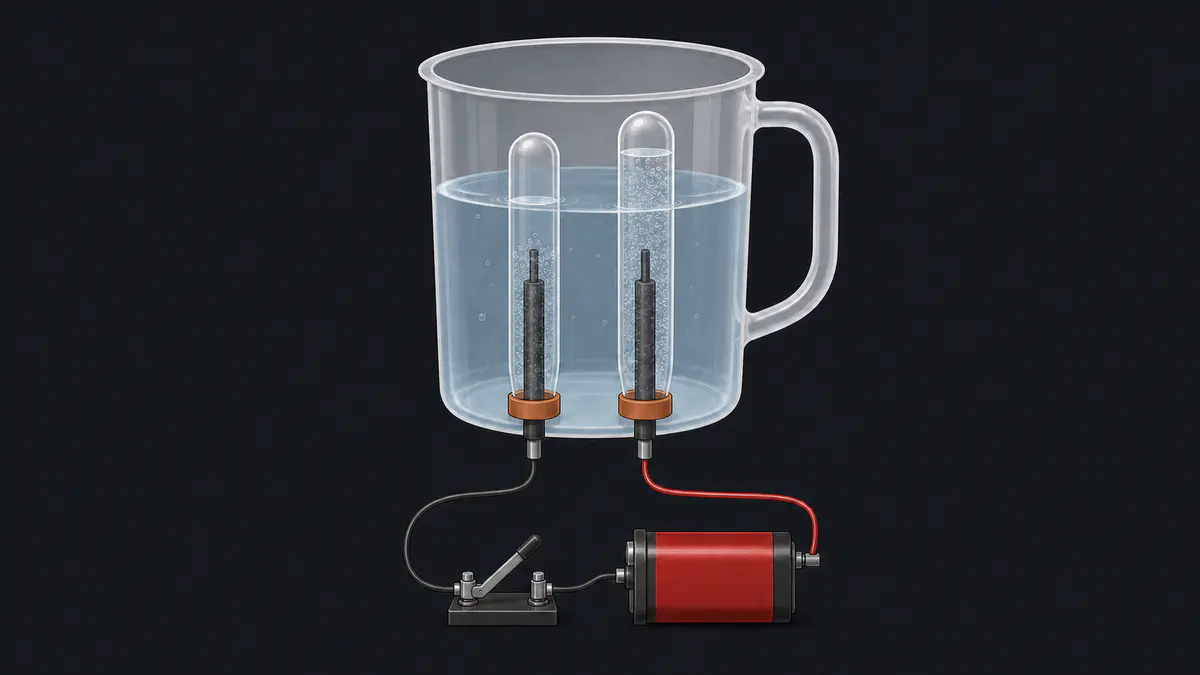
Drill two holes at the base of a plastic mug and fit rubber stoppers in them.
Insert carbon electrodes through the stoppers and connect them to a 6 V battery.
Fill the mug with water so that the electrodes are immersed. Add a few drops of dilute sulphuric acid.
Fill two test tubes with water and invert one over each electrode.
Switch on the current. Bubbles displace water from both test tubes.
Compare the gas volumes. Remove the filled tubes carefully.
Let the teacher bring a burning candle near each tube and identify the gases from their behaviour.
Observation: Hydrogen forms at the cathode. Oxygen forms at the anode. The volume of hydrogen is about twice the volume of oxygen because water contains hydrogen and oxygen in a 2:1 ratio.
1
2
3
4
5
6
7
8
9
1Plastic mug
2Acidified water
3Graphite electrodes
4Rubber stoppers
5Inverted test tubes
6Switch
76 V battery
8Hydrogen
9Oxygen
NCERT Figure 1.6 · Activity 1.7
Electrolysis of water
A 6 V battery passes current through acidified water using base-mounted graphite electrodes and inverted collection tubes.
What to observe: Hydrogen collects in about twice the volume of oxygen.
Figure 1.6 Electrolysis of water.
2H₂O(l) →[Electricity] 2H₂(g) + O₂(g)
NCERT leaves this activity equation unnumbered. It must not be labelled (1.21).
Board extension: Electrolysis details
Pure water conducts electricity very poorly. A few drops of dilute sulphuric acid provide ions, so current can pass through the water more easily. In this experiment, the acid mainly helps conduction; the chapter equation still shows water decomposing.
Use this electrode map:
Cathode: hydrogen gas, H₂
Anode: oxygen gas, O₂
Volume ratio, cathode:anode:2:1
Mass ratio, cathode:anode:4:32 = 1:8
Why are the two ratios different? The balanced equation gives two molecules of H₂ for one molecule of O₂, so the volume ratio is 2:1. But H₂ is much lighter than O₂. Two moles of H₂ have a mass of 4 g, while one mole of O₂ has a mass of 32 g.
[TIP: First check whether the question asks for volume or mass. Volume is 2:1; mass is 1:8, written in cathode:anode order.]
Activity 1.8 Sunlight on silver chloride
Take about 2 g silver chloride in a china dish and note its white colour.
Place the dish in sunlight for some time.
Observe the colour after exposure.
Observation: White silver chloride turns grey because light decomposes it into silver and chlorine.
1
2
3
4
1China dish
2Silver chloride
3Sunlight
4Silver
NCERT Figure 1.7 · Activity 1.8
Silver chloride in sunlight
White silver chloride in a china dish is exposed to sunlight.
What to observe: It turns grey because silver forms.
Figure 1.7 Silver chloride turns grey in sunlight to form silver metal.
2AgCl(s) →[Sunlight] 2Ag(s) + Cl₂(g)(1.22)
Silver bromide behaves in the same way:
2AgBr(s) →[Sunlight] 2Ag(s) + Br₂(g)(1.23)
These light-sensitive reactions were used in black-and-white photography. This is called photochemical decomposition or photolytic decomposition.
Board application: Silver chloride is kept in a dark-coloured container when light exposure must be prevented. The container blocks the energy that would otherwise start its photolytic decomposition.
What form of energy is causing these decomposition reactions?
Heat, electricity and light supply the energy needed to break down reactants. A reaction that absorbs energy is endothermic.
Carry out the following activity
Take about 2 g barium hydroxide in a test tube.
Add 1 g ammonium chloride and mix with a glass rod.
Touch the bottom of the test tube with your palm.
Decide whether the change is exothermic or endothermic.
Observation: The test tube feels cold because the reaction absorbs energy. It is endothermic.
Figure 1.9
Formation of barium sulphate and sodium chloride.
Observation: A white insoluble substance forms. An insoluble solid formed in a solution is a precipitate, and a reaction producing it is a precipitation reaction.
Ba²⁺ and SO₄²⁻ form insoluble BaSO₄; sodium chloride remains in solution. The reacting compounds exchange ions, so this is a double displacement reaction.
Recall Activity 1.2
Lead(II) nitrate solution was mixed with potassium iodide solution.
What was the colour of the precipitate? Name it.
Write the balanced chemical equation.
Is this also a double displacement reaction?
Answers:
The precipitate was yellow lead iodide, PbI₂.
Pb(NO₃)₂(aq) + 2KI(aq) → PbI₂(s) + 2KNO₃(aq)
Yes. The two compounds exchange ions and form insoluble lead iodide.
Fast distinction: Displacement means one element replaces another. Double displacement means two compounds exchange ions.
Board extension: Double displacement without a precipitate
This extension connects Chapter 1 classification with a current CBSE mixed-chapter pattern. It is not an additional NCERT section.
2NaOH(aq) + H₂SO₄(aq) → Na₂SO₄(aq) + 2H₂O(l)
Sodium hydroxide is a base and sulphuric acid is an acid, so this is a neutralisation reaction.
The ions exchange partners, so it is also a double displacement reaction.
It is not a precipitation reaction because sodium sulphate is soluble and no insoluble solid forms.
Do not use “double displacement” and “precipitation” as if they always mean the same thing. First identify ion exchange; then check whether an insoluble solid actually appears.
Board extension: Non-metal displacement
Displacement is not limited to metals. A more reactive non-metal can also displace a less reactive non-metal from its compound.
Cl₂(g) + 2KI(aq) → 2KCl(aq) + I₂(s)
Chlorine displaces iodine from potassium iodide. In a case-based answer, state the displacement pattern and balance the iodine and potassium compounds with coefficient 2.
Copper is
malleable
, so it can be made into thin sheets and shaped for roofs, domes and similar structures.
For a material-choice answer, do not write only “copper corrodes less.” Name the coating, compare what the two coatings do, and connect the chosen material property to its use.
Find the reactant that gains oxygen or loses hydrogen. It is oxidised, so it is the reducing agent.
Find the reactant that loses oxygen or gains hydrogen. It is reduced, so it is the oxidising agent.
Pass 2 - Use simple oxidation numbers only when oxygen or hydrogen transfer is not obvious.
An element by itself has oxidation number 0.
Hydrogen is usually +1.
Oxygen is usually -2.
Fluorine is always -1.
The oxidation numbers in a neutral compound add to 0.
An increase means oxidation. A decrease means reduction.
The substance whose oxidation number increases is the reducing agent. The substance whose oxidation number decreases is the oxidising agent.
[TIP: Do not guess the agent from its name or from the side of the equation. Show the change first, then name the agent.]
PYQ 3 - Linked decomposition and combination reactions - 5 marks
(i) Define a decomposition reaction. How can we say that (I) electrolysis of water, and (II) blackening of silver bromide when exposed to sunlight, are decomposition reactions? Mention the type of energy involved in each case.
(ii) "The type of reactions in which (I) calcium oxide is formed, and (II) calcium hydroxide is formed are opposite reactions to each other." Justify this statement with the help of chemical equations.
Write before checking
PYQ 3 written attempt
5 marks · Attempt 1
PYQ 4 - Precipitation, ions and whitewashing chemistry - 5 marks
Lead nitrate + Potassium iodide → Lead iodide + Potassium nitrate
Is this a double displacement reaction? Justify your answer. Name the compound precipitated and write the ions present in it.
(ii) Write the method of preparation of Ca(OH)₂. What happens when CO₂ is passed through it? Write the balanced chemical equation for the reaction involved.
Write before checking
PYQ 4 written attempt
5 marks · Attempt 1
PYQ 5 - Conservation of mass and unfamiliar balancing - 3 marks
(i) While electrolysing water before passing the current some drops of an acid are added. Why? Name the gases liberated at cathode and anode. Write the relationship between the volume of gas collected at anode and the volume of gas collected at cathode.
(ii) What is observed when silver chloride is exposed to sunlight? Give the type of reaction involved.
Write before checking
PYQ 8 written attempt
3 marks · Attempt 1
PYQ 9 - Lead nitrate decomposition and gas mass ratio - 3 marks
(i) Define a decomposition reaction. Write chemical equation for the reaction that occurs when lead nitrate is heated strongly in a boiling tube.
(ii) In electrolytic decomposition of water two gases are liberated at the electrodes. Give the mass ratio of the gas liberated at the cathode and at the anode.
Write before checking
PYQ 9 written attempt
3 marks · Attempt 1
An iron nail is placed in blue copper sulphate solution. A copper strip is placed in pale-green iron sulphate solution.
State the observation in each test tube.
Write the balanced equation for the reaction that occurs.
Use relative reactivity to explain why the other test tube shows no reaction.
Write before checking
Current-pattern challenge 2
2 marks · Attempt 1
Current-pattern challenge 3 - Diagnose an electrolysis setup - 3 marks
A student connects two electrodes to a battery and dips them in distilled water. The bulb does not glow and no gas is collected.
Explain why the setup does not work.
Name one substance that can be added in a small amount to make the solution conduct.
If the corrected setup works, name the gas expected at each electrode.
Write before checking
Current-pattern challenge 3
3 marks · Attempt 1
Current-pattern challenge 4 - Evaluate a corrosion decision - 3 marks
An old building has thin copper roof sheets that have developed a green coating. The owner proposes replacing them with unpainted iron sheets because the copper has “started corroding.”
Name the green substance formed on copper. (1)
Should unpainted iron replace the copper merely to avoid corrosion? Compare what happens to the two corrosion coatings. (1)
State the property that allows copper to be made into thin shaped roof sheets. (1)
Write before checking
Current-pattern challenge 4
3 marks · Attempt 1
Current-pattern challenge 5 - Classify beyond the obvious - 3 marks
A student mixes aqueous sodium hydroxide with dilute sulphuric acid. Sodium sulphate and water form.
Write the balanced equation. (1)
Give two valid classifications for the reaction. (1)
Explain why it is not a precipitation reaction. (1)
Write before checking
Current-pattern challenge 5
3 marks · Attempt 1
(a) Name the reaction type in test tube A.
(1)
(b) State one colour observation in test tube B. (1)
(c) Write the balanced equation for the change in dish C. (1)
(d) Name the form of energy responsible for the change in dish C. (1)
Electricity splits water:
2H₂O(l) →[Electricity] 2H₂(g) + O₂(g)
. Electrical energy is supplied.
Light decomposes silver bromide: 2AgBr(s) →[Sunlight] 2Ag(s) + Br₂(g). Light energy is supplied.
Calcium oxide is formed by an endothermic decomposition reaction: CaCO₃(s) →[Heat] CaO(s) + CO₂(g).
Calcium hydroxide is formed by an exothermic combination reaction: CaO(s) + H₂O(l) → Ca(OH)₂(aq) + Heat.
Decomposition is one-to-many; combination is many-to-one. Their patterns are opposite.
PYQ 4
Platform marking points:
(i) Pb(NO₃)₂(aq) + 2KI(aq) → PbI₂(s) + 2KNO₃(aq)
It is double displacement because the two compounds exchange ions.
Yellow lead iodide is precipitated. Its ions are Pb²⁺ and I⁻.
(ii) Calcium hydroxide is prepared by adding water to quicklime: CaO(s) + H₂O(l) → Ca(OH)₂(aq) + Heat.
When carbon dioxide is passed through calcium hydroxide, the solution turns milky white because calcium carbonate forms: Ca(OH)₂(aq) + CO₂(g) → CaCO₃(s) + H₂O(l).
PYQ 5
Platform marking points:
A chemical equation is balanced because atoms are neither created nor destroyed during a reaction.
The law is the law of conservation of mass: mass can neither be created nor destroyed in a chemical reaction.
3Zn + 2H₃PO₄ → Zn₃(PO₄)₂ + 3H₂
Check: Zn = 3, P = 2, O = 8 and H = 6 on each side.
PYQ 6
Platform marking points:
(a) A reddish-brown copper coating forms on the nail and the blue solution turns pale green: Fe(s) + CuSO₄(aq) → FeSO₄(aq) + Cu(s).
(b) A yellow lead iodide precipitate forms: Pb(NO₃)₂(aq) + 2KI(aq) → PbI₂(s) + 2KNO₃(aq).
(a)(i) NH₃ is the reducing agent. Nitrogen changes from -3 in NH₃ to +2 in NO, so ammonia is oxidised.
(a)(ii) H₂O is the reducing agent. Oxygen changes from -2 in H₂O to 0 in HOF, so water is oxidised.
(a)(iii) CO is the reducing agent. It gains oxygen to form CO₂, so it is oxidised.
(a)(iv) H₂ is the reducing agent. It gains oxygen to form water, so it is oxidised.
(b) A redox reaction is one in which oxidation and reduction occur together. Oxidation is gain of oxygen or loss of hydrogen; reduction is loss of oxygen or gain of hydrogen.
PYQ 8
Platform marking points:
(i) Dilute acid supplies ions and increases the electrical conductivity of water.
Hydrogen gas is liberated at the cathode. Oxygen gas is liberated at the anode.
The anode:cathode volume ratio is 1:2.
(ii) White silver chloride turns grey because silver forms.
The reaction is photochemical or photolytic decomposition: 2AgCl(s) →[Sunlight] 2Ag(s) + Cl₂(g).
PYQ 9
Platform marking points:
(i) In a decomposition reaction, one reactant breaks into two or more products.
2Pb(NO₃)₂(s) →[Heat] 2PbO(s) + 4NO₂(g) + O₂(g)
Brown nitrogen dioxide fumes are released.
(ii) Hydrogen forms at the cathode and oxygen at the anode.
Cathode:anode mass ratio H₂:O₂ = 4:32 = 1:8.
Current-pattern challenge 1
Fe₂O₃ + 2Al → Al₂O₃ + 2Fe
2C₂H₆ + 7O₂ → 4CO₂ + 6H₂O
Both are redox reactions because oxidation and reduction occur together.
In the first reaction, aluminium is oxidised and iron(III) oxide is reduced.
Current-pattern challenge 2
The iron nail gets a reddish-brown copper coating and the blue copper sulphate solution turns pale green.
Fe(s) + CuSO₄(aq) → FeSO₄(aq) + Cu(s)
The copper strip in iron sulphate solution shows no reaction.
Iron is more reactive than copper, so iron displaces copper; copper cannot displace iron.
Current-pattern challenge 3
Distilled water contains too few ions and is a poor conductor, so current does not pass effectively.
A few drops of dilute sulphuric acid can be added to supply ions. It is used as the electrolyte, not as the gas-forming reactant.
Hydrogen is collected at the cathode and oxygen at the anode.
Current-pattern challenge 4
The green coating is basic copper carbonate.
Do not replace copper with unpainted iron merely to avoid corrosion. Copper's coating remains attached and protects the metal below, whereas iron rust is loose and flaky and keeps exposing fresh iron.
Copper is malleable, so it can be made into thin sheets and shaped for the roof.
Current-pattern challenge 5
2NaOH(aq) + H₂SO₄(aq) → Na₂SO₄(aq) + 2H₂O(l)
It is neutralisation because an acid and a base form salt and water. It is also double displacement because the ions exchange partners.
It is not precipitation because sodium sulphate is soluble and no insoluble solid forms.
Assertion-Reason answers
Option 1. Both statements are true, and the release of heat explains why the quicklime reaction is exothermic.
Option 1. Both statements are true, and photochemical decomposition explains why silver chloride must be protected from light.
Case-based answer
(a) Thermal decomposition.
(b) The blue solution fades and becomes pale green, or a reddish-brown copper coating forms on the nail.
(c) 2AgCl(s) →[Sunlight] 2Ag(s) + Cl₂(g)
(d) Light energy.
Respiration releases energy when glucose reacts with oxygen, so it is exothermic. C₆H₁₂O₆(aq) + 6O₂(aq) → 6CO₂(aq) + 6H₂O(l) + Energy. Award one point for the explanation and one for the equation.
Section C
Any two source observations: green crystals first lose water/change colour; a brown solid forms; gases with the smell of burning sulphur are released. It is thermal decomposition. 2FeSO₄(s) →[Heat] Fe₂O₃(s) + SO₂(g) + SO₃(g). Award one point for two observations, one for type and one for the equation.
A yellow PbI₂ precipitate forms. Pb(NO₃)₂(aq) + 2KI(aq) → PbI₂(s) + 2KNO₃(aq). It is double displacement because ions exchange partners, and precipitation because an insoluble solid forms. Award one point each for observation, equation and both linked classifications.