Activity 1.5 Heating ferrous sulphate crystals
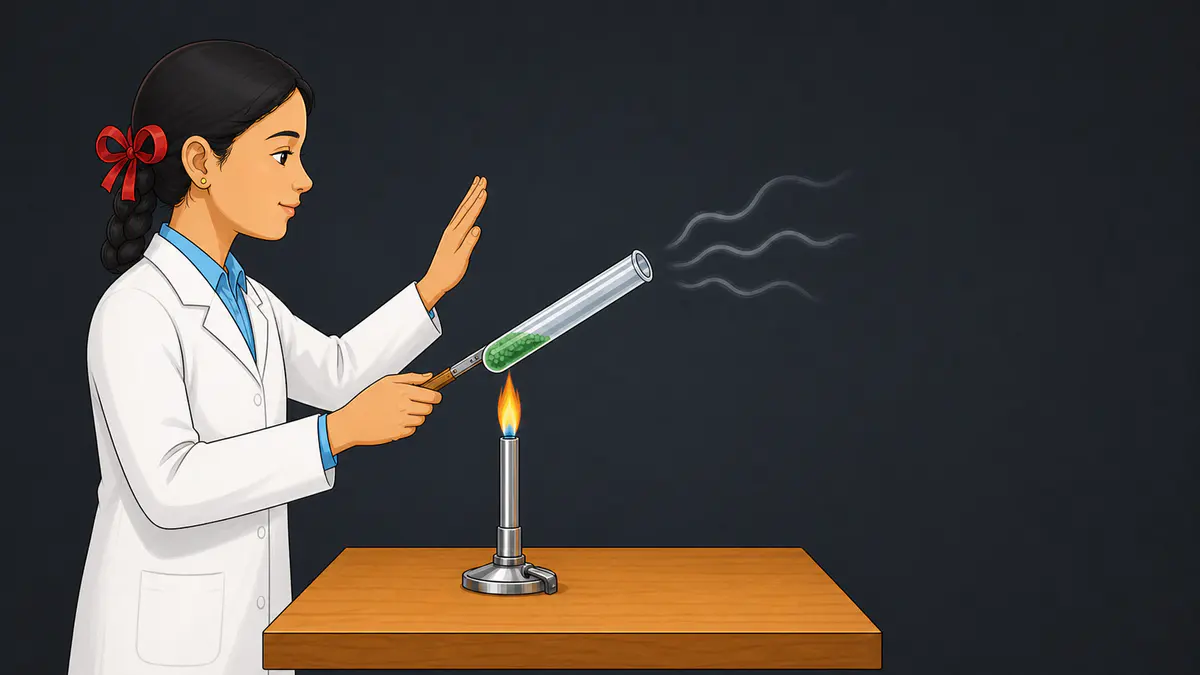
Caution: Keep the mouth of the boiling tube pointed away from yourself and others. If the odour is checked, gently waft the gas towards the nose; do not smell it directly.
- Take about 2 g ferrous sulphate crystals in a dry boiling tube.
- Note their green colour.
- Heat the tube over a burner or spirit lamp as shown in Figure 1.4.
- Observe the colour after heating and the characteristic odour of burning sulphur.
Observation and explanation: Green FeSO₄·7H₂O crystals first lose water on heating. The remaining ferrous sulphate then decomposes. Brown ferric oxide remains, while sulphur dioxide and sulphur trioxide escape as gases.
Figure 1.4 Correct way of heating a boiling tube containing ferrous sulphate crystals and of smelling the odour.
2FeSO₄(s) →[Heat] Fe₂O₃(s) + SO₂(g) + SO₃(g) (1.19)
One reactant forms two or more simpler products. This is a decomposition reaction.
Calcium carbonate decomposes on heating. This industrial reaction is used in the manufacture of cement:
CaCO₃(s) →[Heat] CaO(s) + CO₂(g) (1.20)
A decomposition reaction caused by heat is called thermal decomposition.
Activity 1.6 Heating lead nitrate
- Take about 2 g lead nitrate powder in a boiling tube.
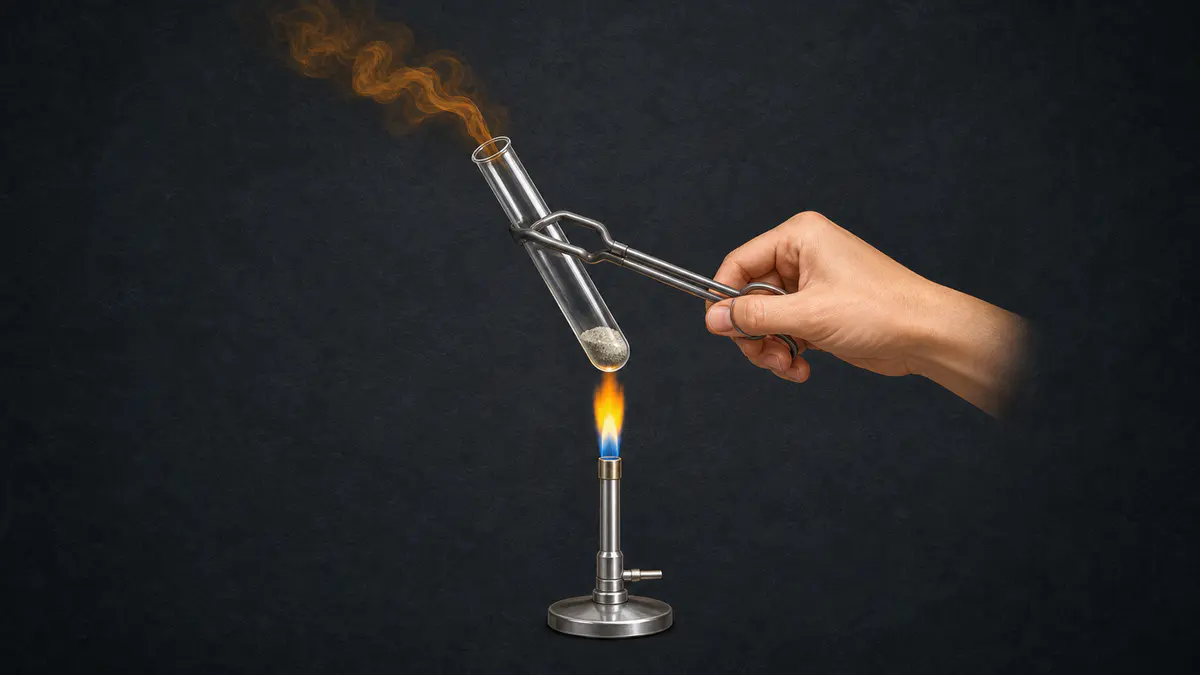
- Hold the boiling tube with a pair of tongs.
- Heat it over a flame as shown in Figure 1.5.
- Record the colour change and fumes.
Observation: Brown fumes of nitrogen dioxide are emitted. Lead oxide and oxygen are also formed.
Figure 1.5 Heating of lead nitrate and emission of nitrogen dioxide.
2Pb(NO₃)₂(s) →[Heat] 2PbO(s) + 4NO₂(g) + O₂(g) (1.21)
Activity 1.7 Electrolysis of water
Caution: The gas test must be performed carefully by the teacher.
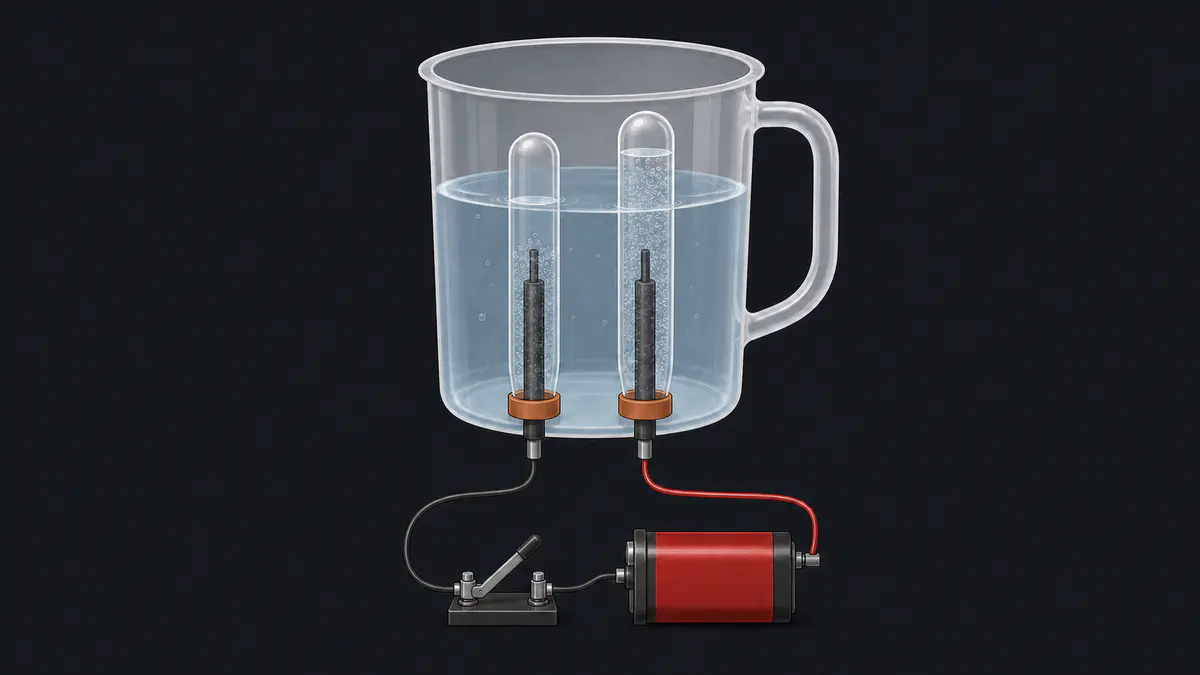
- Drill two holes at the base of a plastic mug and fit rubber stoppers in them.
- Insert carbon electrodes through the stoppers and connect them to a 6 V battery.
- Fill the mug with water so that the electrodes are immersed. Add a few drops of dilute sulphuric acid.
- Fill two test tubes with water and invert one over each electrode.
- Switch on the current. Bubbles displace water from both test tubes.
- Compare the gas volumes. Remove the filled tubes carefully.
- Let the teacher bring a burning candle near each tube and identify the gases from their behaviour.
Observation: Hydrogen forms at the cathode. Oxygen forms at the anode. The volume of hydrogen is about twice the volume of oxygen because water contains hydrogen and oxygen in a 2:1 ratio.
Figure 1.6 Electrolysis of water.
2H₂O(l) →[Electricity] 2H₂(g) + O₂(g)
NCERT leaves this activity equation unnumbered. It must not be labelled (1.21).
Board extension: Electrolysis details
Pure water conducts electricity very poorly. A few drops of dilute sulphuric acid provide ions, so current can pass through the water more easily. In this experiment, the acid mainly helps conduction; the chapter equation still shows water decomposing.
Use this electrode map:
- Cathode: hydrogen gas,
H₂ - Anode: oxygen gas,
O₂ - Volume ratio, cathode:anode:
2:1 - Mass ratio, cathode:anode:
4:32 = 1:8
Why are the two ratios different? The balanced equation gives two molecules of H₂ for one molecule of O₂, so the volume ratio is 2:1. But H₂ is much lighter than O₂. Two moles of H₂ have a mass of 4 g, while one mole of O₂ has a mass of 32 g.
[TIP: First check whether the question asks for volume or mass. Volume is 2:1; mass is 1:8, written in cathode:anode order.]
Activity 1.8 Sunlight on silver chloride
- Take about 2 g silver chloride in a china dish and note its white colour.
- Place the dish in sunlight for some time.
- Observe the colour after exposure.
Observation: White silver chloride turns grey because light decomposes it into silver and chlorine.
Figure 1.7 Silver chloride turns grey in sunlight to form silver metal.
2AgCl(s) →[Sunlight] 2Ag(s) + Cl₂(g) (1.22)
Silver bromide behaves in the same way:
2AgBr(s) →[Sunlight] 2Ag(s) + Br₂(g) (1.23)
These light-sensitive reactions were used in black-and-white photography. This is called photochemical decomposition or photolytic decomposition.
Board application: Silver chloride is kept in a dark-coloured container when light exposure must be prevented. The container blocks the energy that would otherwise start its photolytic decomposition.
What form of energy is causing these decomposition reactions?
Heat, electricity and light supply the energy needed to break down reactants. A reaction that absorbs energy is endothermic.
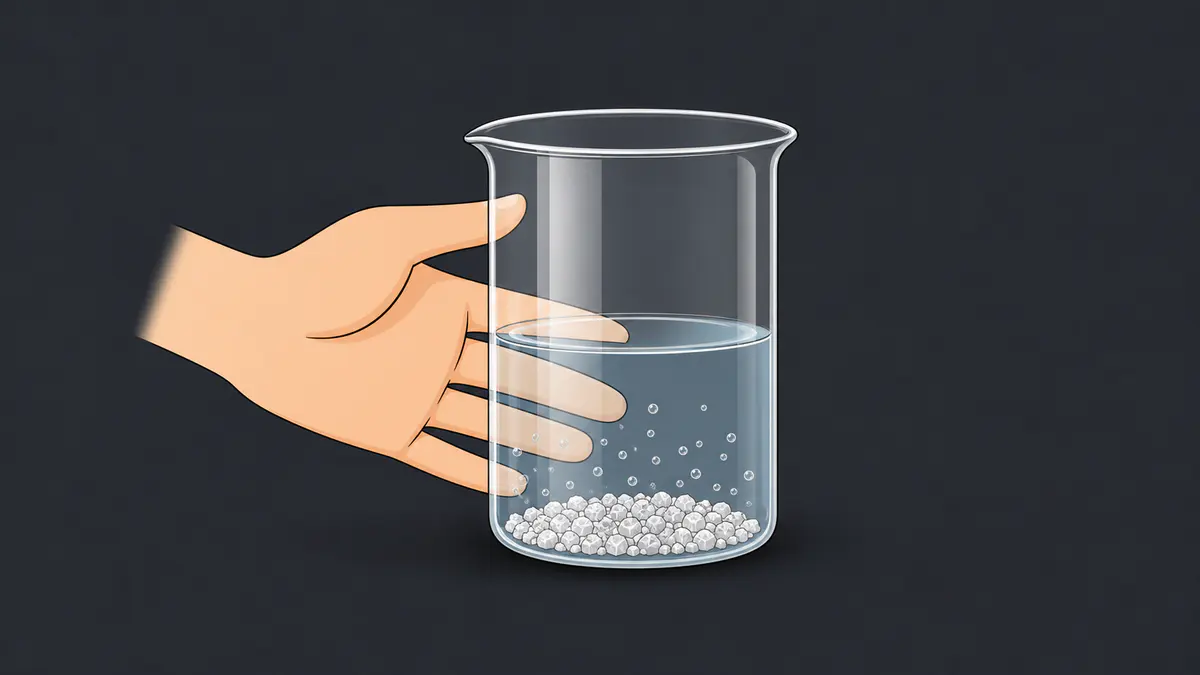
Carry out the following activity
- Take about 2 g barium hydroxide in a test tube.
- Add 1 g ammonium chloride and mix with a glass rod.
- Touch the bottom of the test tube with your palm.
- Decide whether the change is exothermic or endothermic.
Observation: The test tube feels cold because the reaction absorbs energy. It is endothermic.