Checking video availability while the notes load...
Lesson note
1.2.5 Oxidation and Reduction; 1.3 Effects of Oxidation in Everyday Life
1.2.5 Oxidation and Reduction
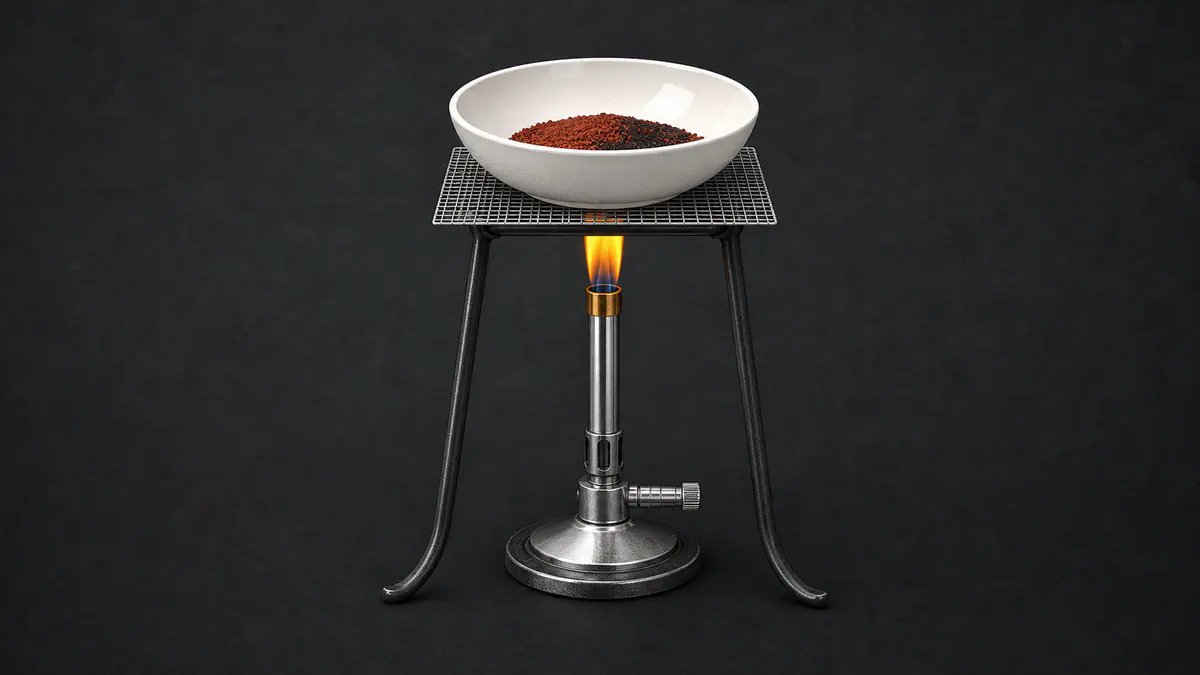
Activity 1.11 Heating copper powder
Place about 1 g copper powder in a china dish.
Heat the dish as shown in Figure 1.10.
Observe the colour of the copper surface.
1
2
3
4
5
6
1China dish
2Copper powder
3Copper oxide
4Wire gauze
5Tripod stand
6Bunsen burner
NCERT Figure 1.10 · Activity 1.11
Heating copper powder
Copper powder is heated in a china dish on wire gauze and a tripod.
What to observe: The reddish-brown copper surface becomes black copper oxide.
Figure 1.10 Oxidation of copper to copper oxide.
What do you observe? Why has this black substance formed?
Observation: The reddish-brown copper surface becomes coated with black copper(II) oxide because oxygen is added to copper.
2Cu + O₂ →[Heat] 2CuO(1.28)
If hydrogen is passed over the heated copper oxide, the black coating turns brown again. Copper oxide loses oxygen and copper is obtained:
CuO + H₂ →[Heat] Cu + H₂O(1.29)
A substance that gains oxygen is oxidised. A substance that loses oxygen is reduced. In equation (1.29), hydrogen gains oxygen and is oxidised, while copper(II) oxide loses oxygen and is reduced. Because the two processes happen together, it is an oxidation-reduction or redox reaction.
CuO + H₂ →[Heat] Cu + H₂O(1.30) Oxidation: H₂ → H₂O Reduction: CuO → Cu
Other redox examples are:
ZnO + C → Zn + CO(1.31)
Carbon gains oxygen and is oxidised to carbon monoxide. Zinc oxide loses oxygen and is reduced to zinc.
MnO₂ + 4HCl → MnCl₂ + 2H₂O + Cl₂(1.32)
Hydrochloric acid loses hydrogen and is oxidised to chlorine. Manganese dioxide loses oxygen and is reduced to manganese chloride; the removed oxygen combines with hydrogen to form water.
In NCERT terms:
Oxidation: gain of oxygen or loss of hydrogen.
Reduction: loss of oxygen or gain of hydrogen.
Study questions
Questions and answers
Question 1
Why does the colour of copper sulphate solution change when an iron nail is dipped in it?
Try first, then reveal the answer
Iron is more reactive than copper, so it displaces copper from copper sulphate. Pale-green iron sulphate forms and copper deposits on the nail; therefore, the blue colour fades.
Question 2
Give an example of a double displacement reaction other than the one given in Activity 1.10.
Try first, then reveal the answer
Pb(NO₃)₂(aq) + 2KI(aq) → PbI₂(s) + 2KNO₃(aq). Lead iodide is a yellow precipitate.
Question 3
Identify the substances that are oxidised and the substances that are reduced in the following reactions.
Try first, then reveal the answer
(i) 4Na(s) + O₂(g) → 2Na₂O(s)Answer: Sodium gains oxygen and is oxidised. Oxygen is reduced while sodium oxide forms.
(ii) CuO(s) + H₂(g) → Cu(s) + H₂O(l)Answer: Hydrogen gains oxygen and is oxidised to water. Copper oxide loses oxygen and is reduced to copper.
1.3 Have You Observed the Effects of Oxidation Reactions in Everyday Life?
1.3.1 Corrosion
New iron articles are shiny, but iron left exposed develops reddish-brown rust. When a metal is attacked by moisture, acids or other substances around it, the metal is said to corrode and the process is called corrosion.
Iron forms reddish-brown rust.
Silver develops a black coating.
Copper develops a green coating.
Corrosion damages car bodies, bridges, iron railings, ships and other metal objects. Rusting causes serious economic loss because damaged iron must be repaired or replaced. Paint limits the contact of iron with air and moisture, so it slows rusting.
Board extension: Copper corrosion and material choice
This extension prepares you for a current CBSE application pattern. It is not an additional NCERT section.
Copper exposed to moist air slowly develops a green coating of basic copper carbonate.
This coating stays attached and helps shield the copper below from further attack.
Iron rust is loose and flaky. When it falls away, fresh iron is exposed and corrosion can continue.
Copper is malleable, so it can be made into thin sheets and shaped for roofs, domes and similar structures.
For a material-choice answer, do not write only “copper corrodes less.” Name the coating, compare what the two coatings do, and connect the chosen material property to its use.
1.3.2 Rancidity
When fats and oils are oxidised, their smell and taste change. This spoilage is called rancidity.
Rancidity can be slowed by:
adding antioxidants to food containing fats and oils;
keeping food in airtight containers;
flushing packets with nitrogen so oxygen cannot easily reach the food.
Recall Activity 1.1
Magnesium burns with a dazzling flame in oxygen and changes into white magnesium oxide. Magnesium gains oxygen, so it is being oxidised.
What you have learnt
A complete chemical equation represents reactants, products and physical states symbolically.
An equation must be balanced so that every element has the same number of atoms on both sides.
Combination reactions form one new substance from two or more substances.
Decomposition reactions split one substance into two or more substances.