Checking video availability while the notes load...
Lesson note
1.2.3 Displacement and 1.2.4 Double Displacement Reactions
1.2.3 Displacement Reaction
Activity 1.9 Iron nails in copper sulphate
Clean three iron nails by rubbing them with sandpaper.
Mark two test tubes as A and B. Put about 10 mL copper sulphate solution in each.
Tie two nails with thread and immerse them in test tube B for about 20 minutes.
Keep the third nail aside for comparison.
Remove the immersed nails after 20 minutes.
Compare the blue colour in test tubes A and B.
Compare the immersed nails with the nail kept aside.
1
2
3
4
5
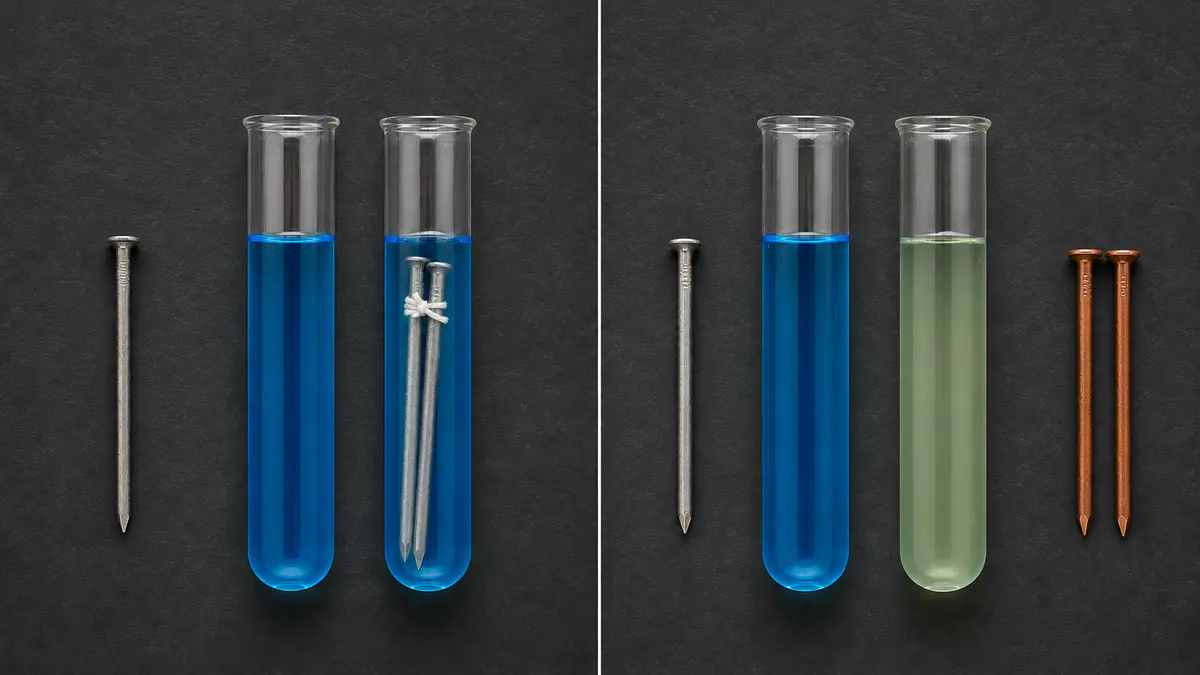
1Clean comparison nail
2Blue copper sulphate control
3Two immersed nails
4Pale-green iron sulphate
5Copper-coated nails
NCERT Figure 1.8(a)-(b) · Activity 1.9
Iron nails in copper sulphate
Three nails and test tubes A/B provide a before-and-after comparison.
What to observe: Two immersed nails gain a copper coating and the reaction solution becomes pale green.
Figure 1.8(a)-(b) Iron nails and copper sulphate solutions compared before and after the experiment.
Observation: The immersed nails become brownish and the blue solution in test tube B fades. Iron is more reactive than copper, so iron displaces copper. Copper deposits on the nails and pale-green iron sulphate forms.
Fe(s) + CuSO₄(aq) → FeSO₄(aq) + Cu(s)(1.24)
A reaction in which a more reactive element removes a less reactive element from its compound is a displacement reaction.
Zn(s) + CuSO₄(aq) → ZnSO₄(aq) + Cu(s)(1.25)
Pb(s) + CuCl₂(aq) → PbCl₂(aq) + Cu(s)(1.26)
Zinc and lead are more reactive than copper, so they displace copper from its compounds.
1.2.4 Double Displacement Reaction
Activity 1.10 Sodium sulphate and barium chloride
Take about 3 mL sodium sulphate solution in one test tube.
Take about 3 mL barium chloride solution in another test tube.
Mix the two solutions.
Record the substance formed.
1
2
3
4
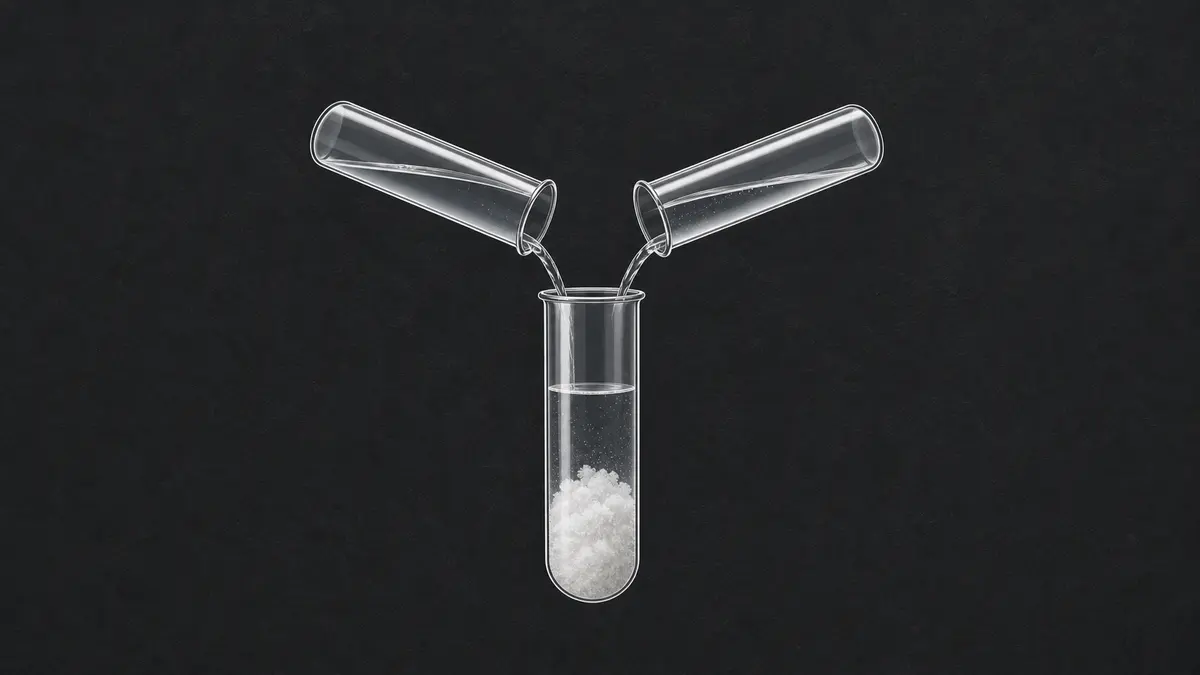
1Sodium sulphate solution
2Barium chloride solution
3Receiving test tube
4Barium sulphate precipitate
NCERT Figure 1.9 · Activity 1.10
Formation of barium sulphate
Separate sodium sulphate and barium chloride solutions are mixed.
What to observe: A white insoluble barium sulphate precipitate forms.
Figure 1.9 Formation of barium sulphate and sodium chloride.
Observation: A white insoluble substance forms. An insoluble solid formed in a solution is a precipitate, and a reaction producing it is a precipitation reaction.
Ba²⁺ and SO₄²⁻ form insoluble BaSO₄; sodium chloride remains in solution. The reacting compounds exchange ions, so this is a double displacement reaction.
Recall Activity 1.2
Lead(II) nitrate solution was mixed with potassium iodide solution.
What was the colour of the precipitate? Name it.
Write the balanced chemical equation.
Is this also a double displacement reaction?
Answers:
The precipitate was yellow lead iodide, PbI₂.
Pb(NO₃)₂(aq) + 2KI(aq) → PbI₂(s) + 2KNO₃(aq)
Yes. The two compounds exchange ions and form insoluble lead iodide.
Fast distinction: Displacement means one element replaces another. Double displacement means two compounds exchange ions.
Board extension: Double displacement without a precipitate
This extension connects Chapter 1 classification with a current CBSE mixed-chapter pattern. It is not an additional NCERT section.
2NaOH(aq) + H₂SO₄(aq) → Na₂SO₄(aq) + 2H₂O(l)
Sodium hydroxide is a base and sulphuric acid is an acid, so this is a neutralisation reaction.
The ions exchange partners, so it is also a double displacement reaction.
It is not a precipitation reaction because sodium sulphate is soluble and no insoluble solid forms.
Do not use “double displacement” and “precipitation” as if they always mean the same thing. First identify ion exchange; then check whether an insoluble solid actually appears.
Board extension: Non-metal displacement
Displacement is not limited to metals. A more reactive non-metal can also displace a less reactive non-metal from its compound.
Cl₂(g) + 2KI(aq) → 2KCl(aq) + I₂(s)
Chlorine displaces iodine from potassium iodide. In a case-based answer, state the displacement pattern and balance the iodine and potassium compounds with coefficient 2.
Common mistakes
Calling the copper coating rust.
Forgetting that both test tubes begin with blue copper sulphate solution.
Calling every double displacement reaction a precipitation reaction; a precipitate must actually form.
Confusing an element replacement with ion exchange.
Board tips
Write the observation before explaining displacement.
Use (s) for the precipitate in a precipitation equation.
Name the more reactive element and the displaced element.
Quick practice
Why does test tube B become less blue in Activity 1.9?
Why is equation (1.27) both double displacement and precipitation?
Practice feedback
Answer check
Try first, then reveal the answer
Blue CuSO₄ is used up and pale-green FeSO₄ forms.
The ions exchange partners and insoluble BaSO₄ forms.
One-minute revision
More reactive elements displace less reactive elements.
Double displacement reactions exchange ions.
A precipitate is an insoluble solid formed from solutions.
End-of-lesson comic recap
Comic recap
Quick scene, quick smile, quick memory. Read this once and the idea sticks better.
4-panel memory strip
Panel 01Priya
Iron is more reactive, so it replaces copper from copper sulphate.
Panel 02Rahul
That one-element replacement is a displacement reaction.
Panel 03Priya
In double displacement, two compounds exchange ions.
Panel 04Rahul
If an insoluble solid forms, the reaction is also precipitation.
Board Readiness Diagnostic B - Transfer Check - 20 Marks